Boasting in Weakness
Pastor Slager teaches from 2 Corinthians 12:1-10 that Christians should boast in weakness rather than strength, because God's grace is sufficient and His power is made perfect through our limitations and thorns.
Primary Verses
Worship Reorients Our Priorities
Worship has this way of reprioritizing and reordering everything. Like when we show up in church and we sing those words, holy, holy, holy, it's like we rightly reorder all of life, right? Like we remember in the moment that God is on the throne. When we sing things like holy, holy, it's not to make him holy. It's not like he forgot that he's holy. He's not holy because we say so. But when we come together to worship him, it's also a reminder to our own heart that God is holy, that God is sovereign, that God is great, that God is wonderful. And rightly order things and remember that he's on the throne, I'm not.
God is holy. Apart from Christ, I'm not. God is wonderful. Apart from his grace, there's really not much wonderful about me. Which is kind of opposite to how we... Normally live our life. I think when we have opportunity to boast, we don't typically boast in God unless we're in church because the Bible says if you're going to boast, boast in Jesus. But when we're just out and about living our normal everyday life, the tendency to boast, the tendency to get puffed up, the tendency to be prideful, to have an ego, to get a big head, however you want to say it. Like that tendency is alive and well in each and every one of us, isn't it?
To figure out is it a thorn is it something else bring that to the lord and profess oh god how i need you maybe this morning you feel the lord pulling the lord drawing you into relationship with himself maybe this morning is the opportunity for you to profess to the lord god i need you our prayer team will be here in just a moment and we'll be right back after this and would love to pray with you this morning for the rest of us remember service isn't over till you love somebody so love somebody well then go out into the world and live on mission for the glory of christ and christ alone we love you may god bless you we'll see you next week bye -bye
The Natural Tendency to Boast
Um, I remember when I was, uh, in undergrad, which is a really snooty way to say that, doesn't that sound pretentious when I was in undergrad, uh, I took this class once called adolescent psychology. And we were talking about, man, why we boast, like, where does that desire to boast come from? Where does that desire to like make much of ourself and why do we do that? Uh, in the person teaching this class that really it's tied to three things are desire to be loved.
Our desire to belong, our desire to be accepted, especially compounded by feelings of just like, I'm just not enough. So what do we do? We boast, um, we inflate stories, right? The fish that we catch are this big, but they're this big, and then they're this big. And then it's the biggest fish in the entire world.
When we're telling stories, like the details can be a little fuzzy, but we inflate things a little to make things sound way more awesome than they are. If we're hanging out with a group of friends, like we want them to love us and accept us. And we want to belong to that click or belong to that group of people. Therefore, like I'm going to project this, like I'm pretty awesome so that I can receive love so that I can be accepted so that I can belong all the while. The gospel of Jesus Christ is we're not enough, but he is the gospel of Jesus says, no, you're not.
Introduction to Paul's Paradox
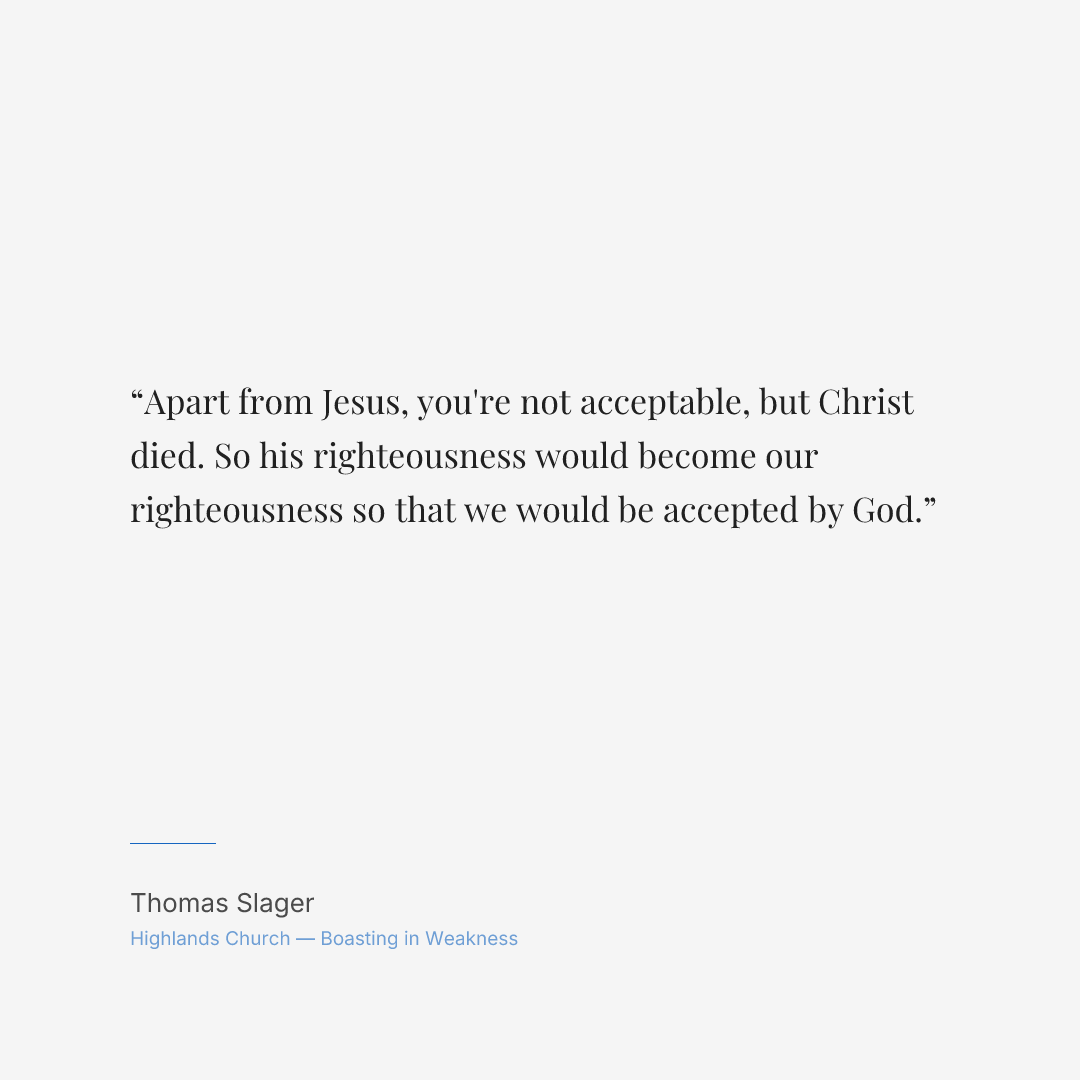
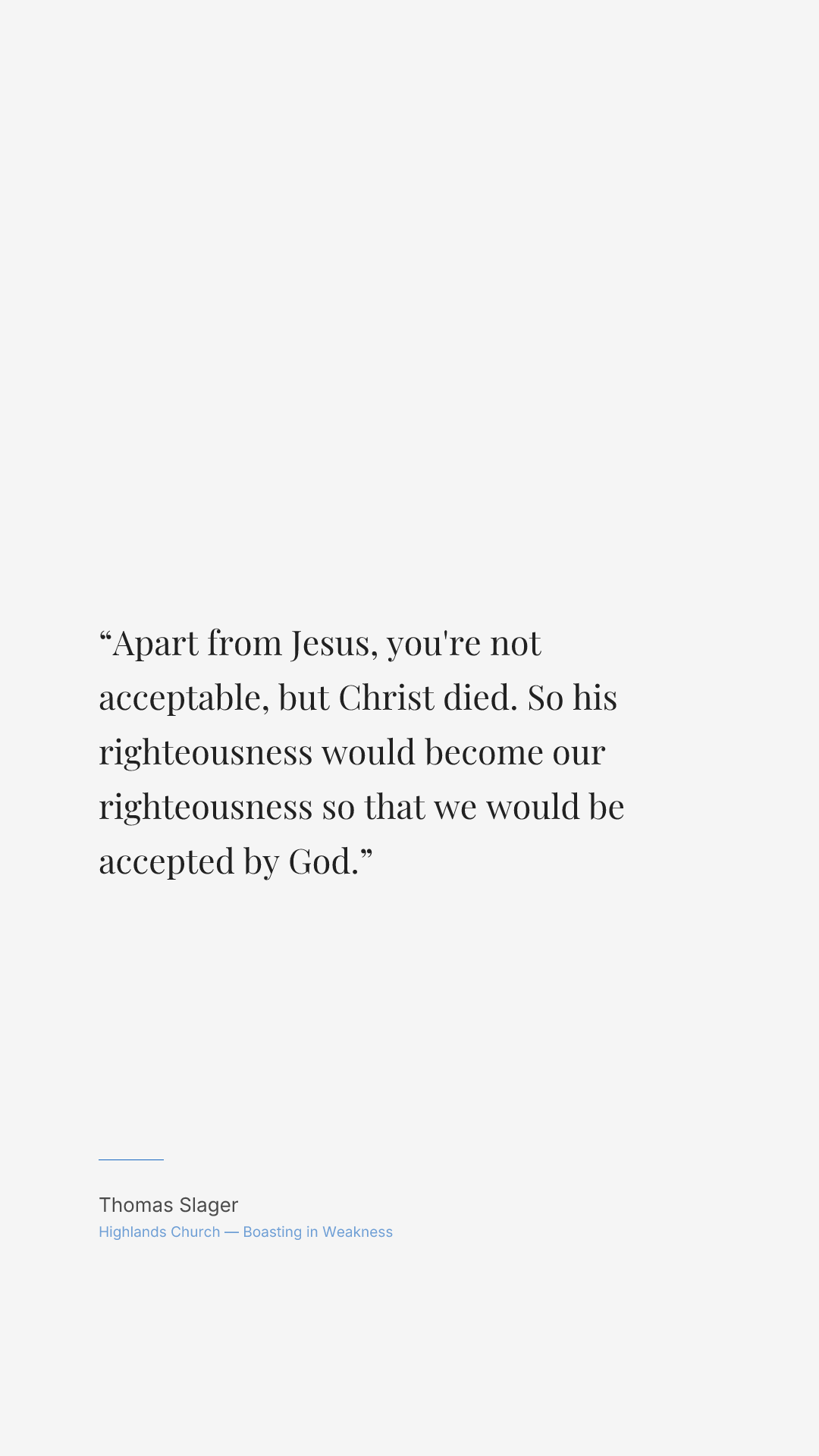
Lovely, but Christ died to make you lovely. The gospel of Jesus. Yeah. Apart from Jesus, you're not acceptable, but Christ died. So his righteousness would become our righteousness so that we would be accepted by God. When we stand before him, the gospel of Jesus is yeah. Outside of Christ, you don't belong to the household of God, but if you believe and you receive, you become a child of God. And now you belong to the family of God.
So we. Believe all these things, but all the while, the tendency to boast, to brag, to be prideful, to be conceited, to get a big head. It's still alive and well in each and every one of us, what we're going to see this morning in second Corinthians 12, our last time in the book of first and second Corinthians, believe it or not. What a joy it's been for me to work through it. I hope it's been a joy for you as a church as well, as we've just studied and done a deep dive on those books. So we're gonna be in second Corinthians chapter 12 verses one through 10. This morning, talking all about boasting Paul says, Hey, if I'm going to boast, I'm going to boast in my weaknesses first and foremost, because through my weaknesses, God is actually strongest.
Scripture Reading: 2 Corinthians 12:1-10
We're going to see Paul talk about this mysterious thorn in the flesh, which you've probably heard about before. Hopefully we can have a little bit of clarity around that this morning. Second Corinthians 12, one through 10. Let me read it. We'll pray. And then we'll dive in second
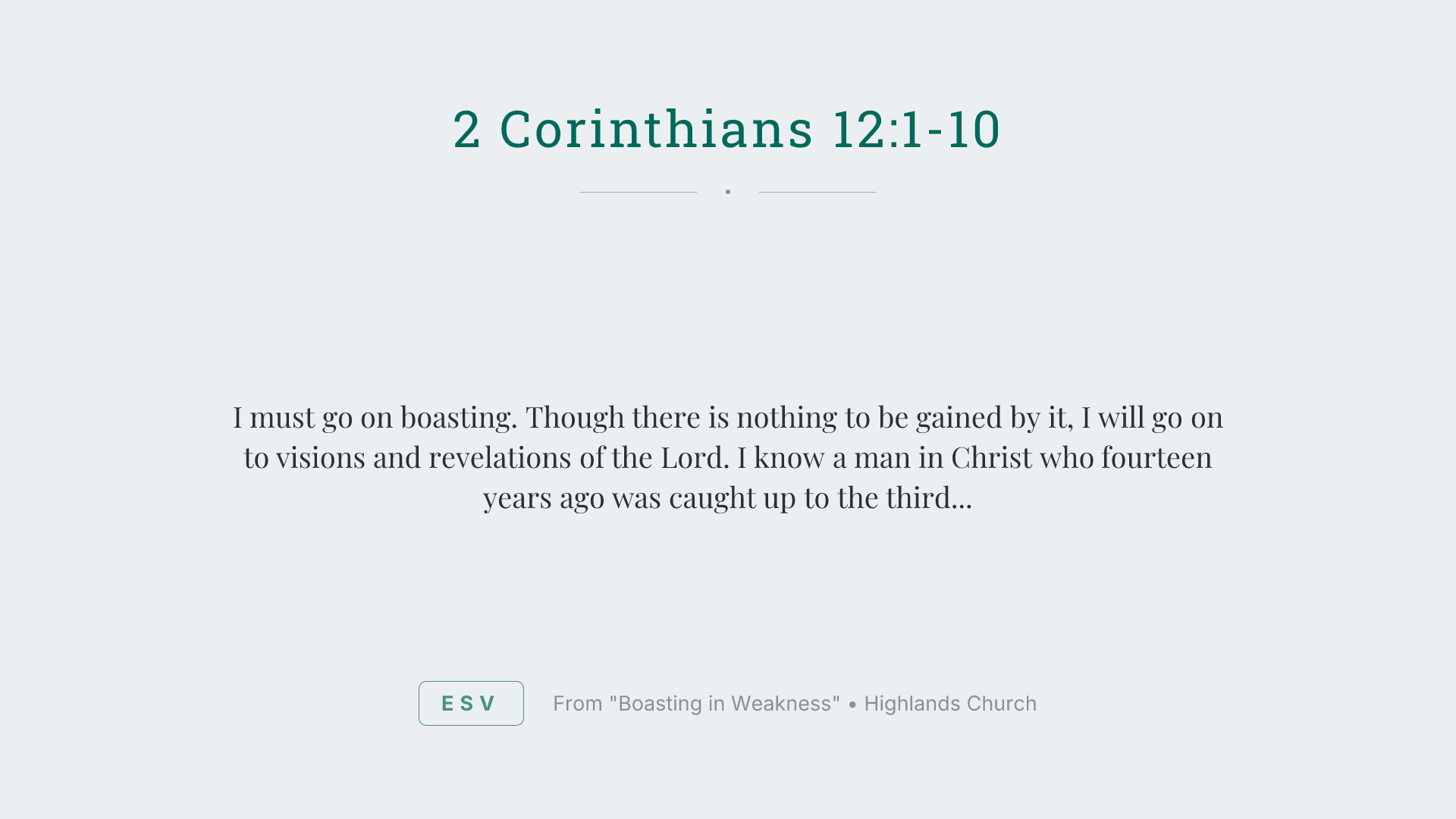
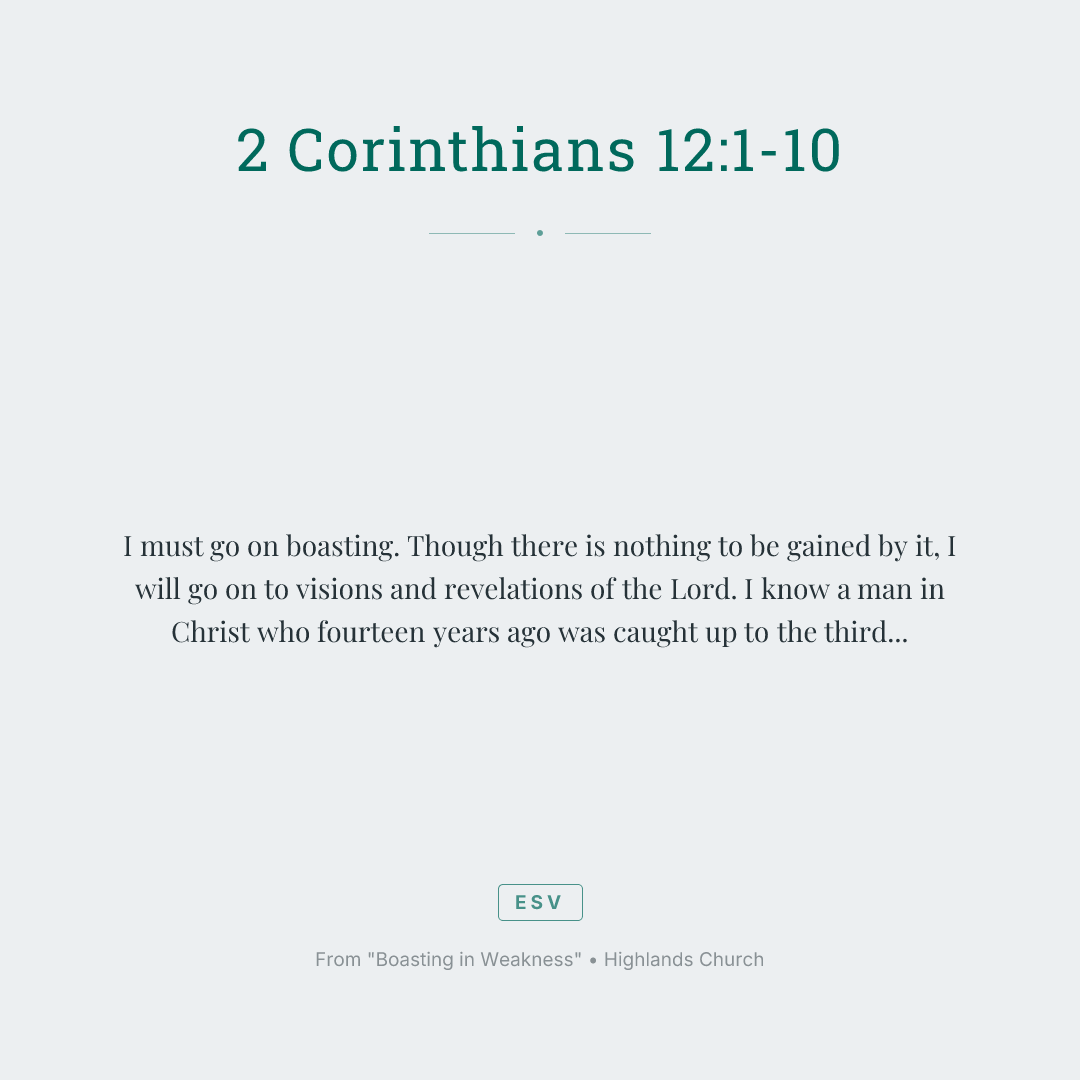
Corinthians chapter 12, Paul says this. I must go on. I must go on boasting though. There's nothing to be gained by it. I will go on divisions and revelations of the Lord. I know a man in Christ who 14 years ago was caught up to the third heaven, whether in the body or out of the body. I don't know, but God knows. And I know that this man was caught up into paradise, whether in the body or out of the body. I don't know. God knows. And he heard things that cannot be told, which man may not utter on behalf of this man. I'll boast, but on my own behalf, I will not boast. Except of my weaknesses, though, if I should wish to boast, I'd not be a fool, for I'd be speaking the truth, but I refrain from it so that no one may think more of me than he sees in me or hears in me.
So to keep me from becoming conceited because of the surpassing greatness of these revelations, a thorn was given me in the flesh, a messenger of Satan to harass me, to keep me from becoming conceited three times. I pleaded with the Lord about this. That it should leave me. But he said to me, my grace is sufficient for you, for my power is made perfect in weakness.
Recognize the Temptation to Pride
Therefore, I will boast all the more gladly of my weaknesses so that the power of Christ may rest upon me. For the sake of Christ, then, I am content with weaknesses, insults, hardships, persecutions, and calamities. For when I am weak, then I am strong. Let me pray.
Father God, while it's my voice that's been heard, we know it's not your voice. It's your word that's been spoken. And this morning, it's your word that we trust for the authority in our life. God, not what society says, not what culture says, not what the news says or our social media say. God, we come before you this morning, opening your word, desiring to submit to you for your glory and your glory alone.
Holy Spirit, I pray this morning you'd open our eyes that we can see your scriptures clearly. You'd open our ears to hear God's voice, our mind to know and understand. Would you open our hearts that we believe, that we love? That we'd have faith. Would you open our mouths to go out into the world to preach the good news of Jesus Christ, who he is and what he's done on our behalf?
Father God, if we boast this morning, let our boast be alone in you for who you are.
Paul Uses Boasting Against the Corinthian Church
Wonderful, matchless, mighty creator who sustains us even in this moment. God, it's you we seek to glorify in everything in this place. It's in Christ's name we pray. Amen. If we boast, we're going to boast in our weaknesses. Four things you'll see in your outline that will guide us through the passage. Those four things are also what I think we can take application from this morning as well. The first thing we see in our text is our need to recognize our natural temptations to pride.
Each and every one of us, whether we like it or not, has this tendency to just preach us. To talk about us. There was a prophet. A profound theological song once written by a man named Toby Keith. I want to talk about, number one, on my, me, my, what I think, what I like, what I know, what I want, what I see. I like talking about me.
Isn't that the truth? Any opportunity. Someone might be telling a great story and you're like, oh, I have a better one. I have a better one.
We all do it. We one -up each other. Or maybe it's not that. You just have this desire. You want a group of people to accept you. You want to belong to something greater than yourself. You just want people to love you. Easiest way to get them to change the way they think about you is make yourself sound more awesome than you actually are.
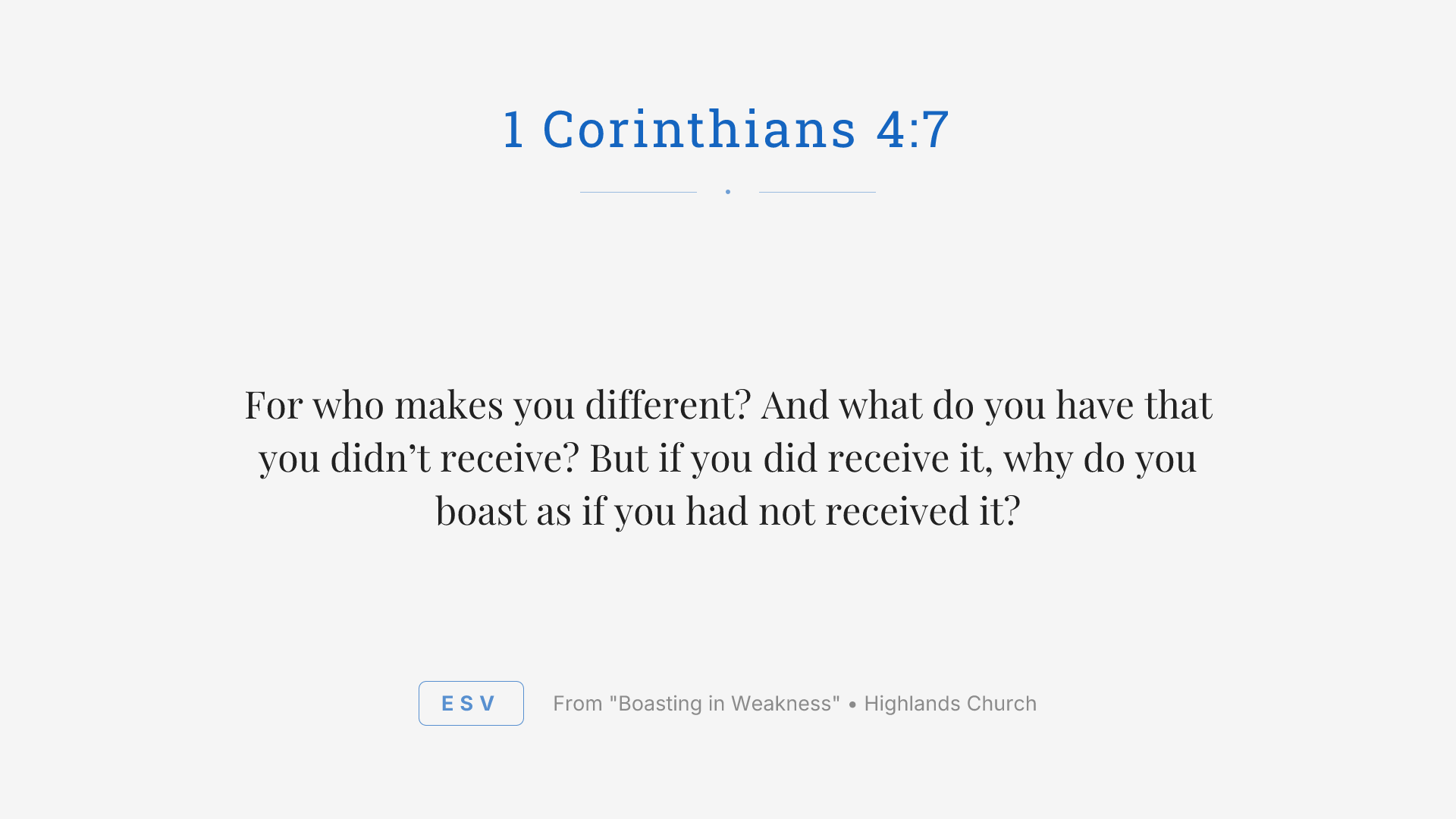
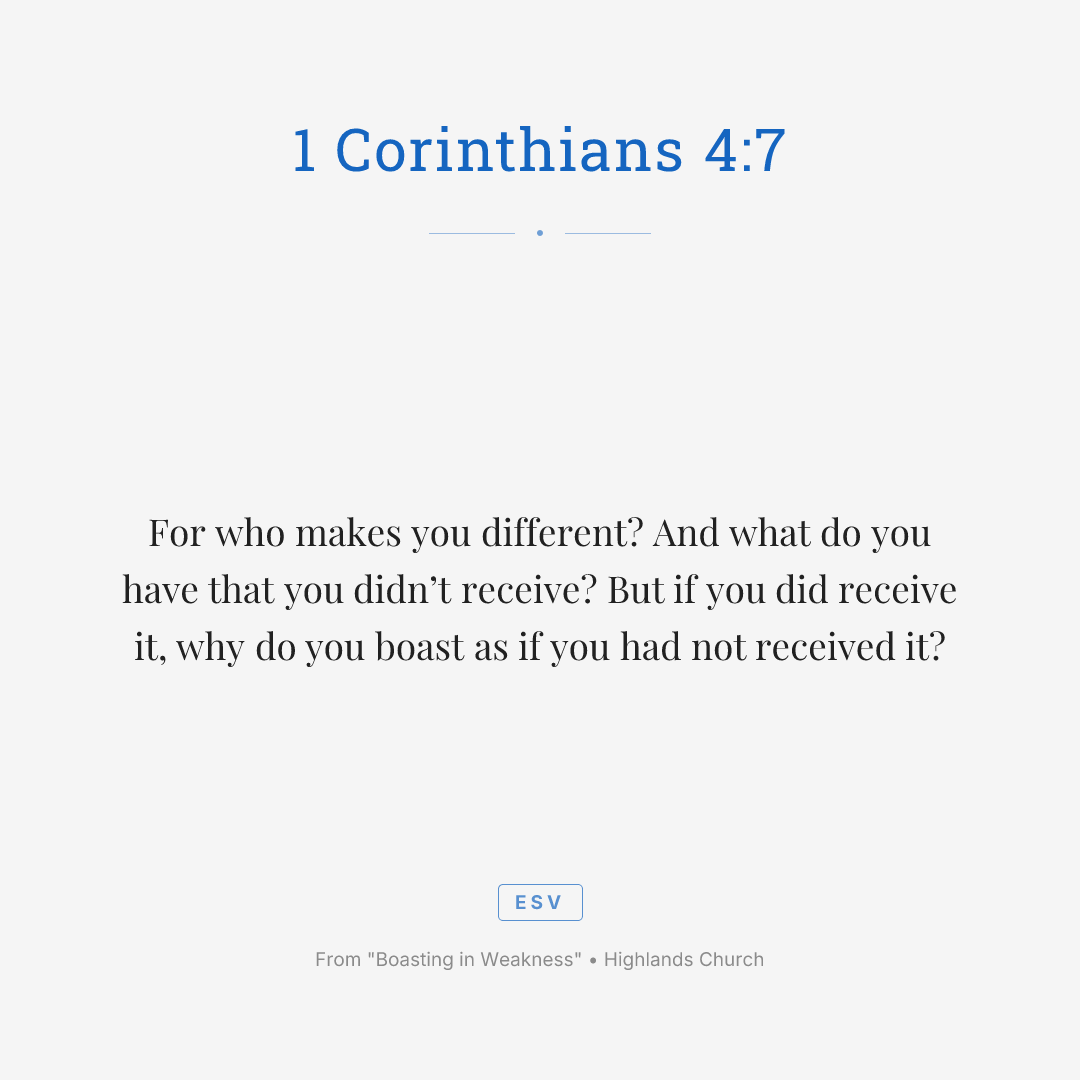
All of us do it. Paul even said in first Corinthians chapter four, he says, why do you boast? First Corinthians chapter four, verse seven. He says, Hey, everything you have has been given you by God. Why do you boast? Is this as if it hasn't been. Like, why do you take credit for the things you shouldn't take credit for? Why do you take credit for the spiritual gifts that God's blessed you with when you're not the one who blessed you with them? They're from God. Now I think of it like this. Have you ever been around a young kid? Uh, it could be a, an elementary school kid. It could be a middle school kid.
It could be anyone with some sick new Jays, awesome shoes, and they're boasting about their really cool shoes, talking about how they're real hot stuff and cool stuff because of these awesome shoes. They got that. That That I'm sure they worked so hard for that. I'm sure they went to work to put those shoes on their feet. I'm sure they, and if this is true of your child, you're teaching next weekend on financial stewardship and how to raise a child who can do such a thing. But the reality is we all know like that kid didn't do that.
That kid boasts in his fancy house that he didn't buy that house. So why is he talking about it as if he did? And Paul's whole thing. It's like, Hey, we got nothing to brag about all of our accomplishments, all of our gifts, gifts from God. Yeah. But I got out there and got after it. Who gave you that work ethic? It's a gift from God, even the good things, even the strengths. If we're going to boast, we're just going to boast in the God who blessed us with the opportunity to go do the things he's created us and designed us to do. This church had a problem with boasting you and I have a problem with boasting, but here in verse one of chapter.
Spiritual Revelations Beyond Physical Credentials
Chapter 12, Paul says, I must go on boasting. Well, that's a little confusing elsewhere. Paul says, if we were going to boast, we're only going to boast in God. We're not going to boast in self. So why in the world would Paul go back on something? He told the very church to not do. I think what he's doing is he's using something against them. See, this church is obsessed.
They're obsessed with success. Um, they're obsessed with, uh, anything that makes you look great. This is why there was all these like. Isms within the church of super Christians and boring Christians, really affluent people who were out there getting after it. And then the poorest of the poor and no one really got along because everyone was so obsessed with just making themselves sound better, but they were infatuated by people who had success. So there were people in the church who were self -proclaimed as they said, super apostles, by the way, anytime someone, um, self acclaims anything, it's just not true. Okay. Greatest golfer in the world. You're not, cause you said it. You're not most handsome as man alive.
You're not by mirror, right? I mean, it's just, we're not, but this church is obsessed with it. So Paul says, Hey, you want to talk about these guys who are real successful with all sorts of street cred, these so -called super apostles who were doing cool things, saying cool things, um, observing really cool things. That's the guys who had an audience with this church in second Corinthians, they were going to the guys who had all the cool things. And Paul, for the purpose of getting their attention says, Hey, I'll play your stupid game too. We want to make this about boasting about who's the best about who's been successful in ministry, Paul says, I'll play along.
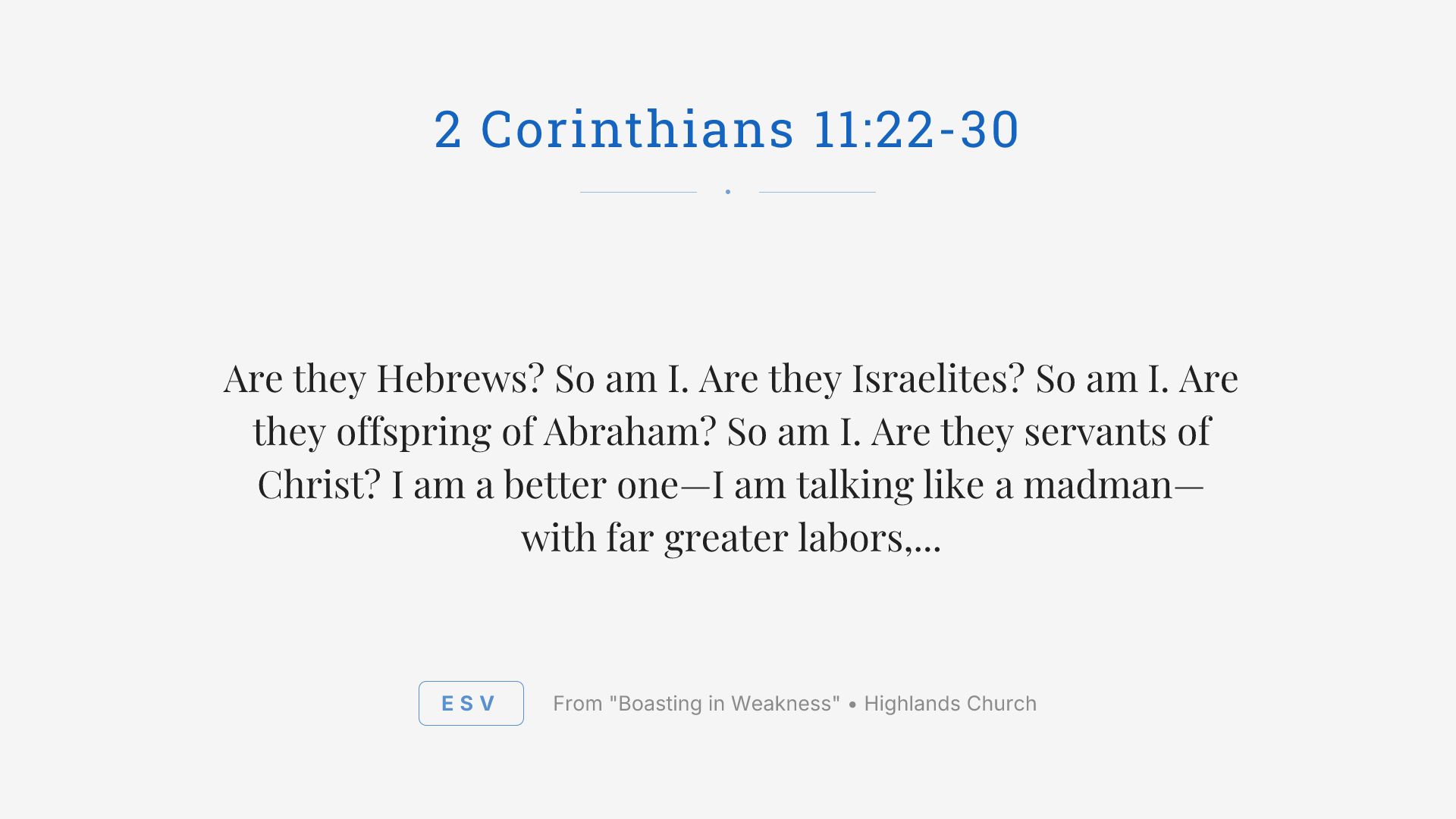
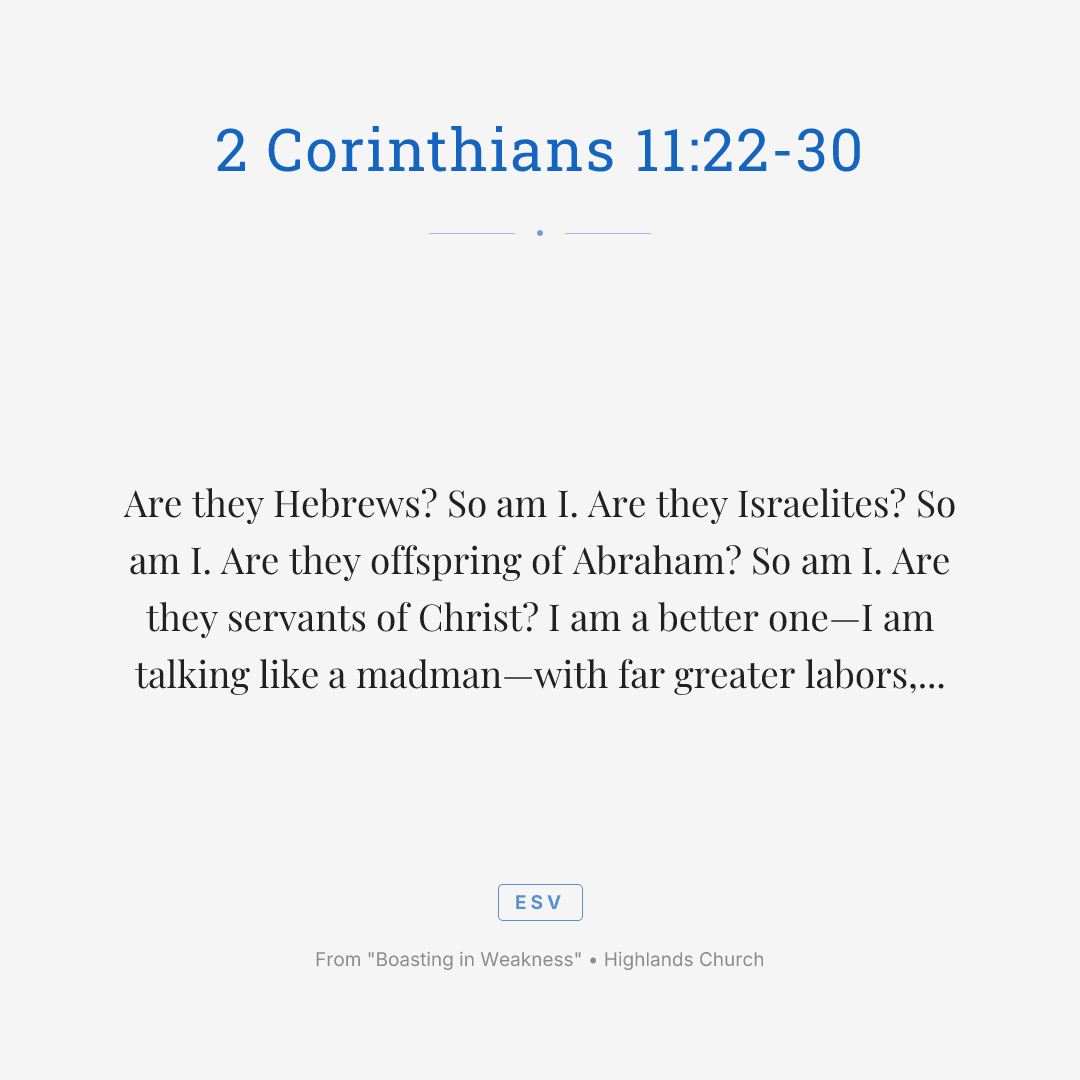
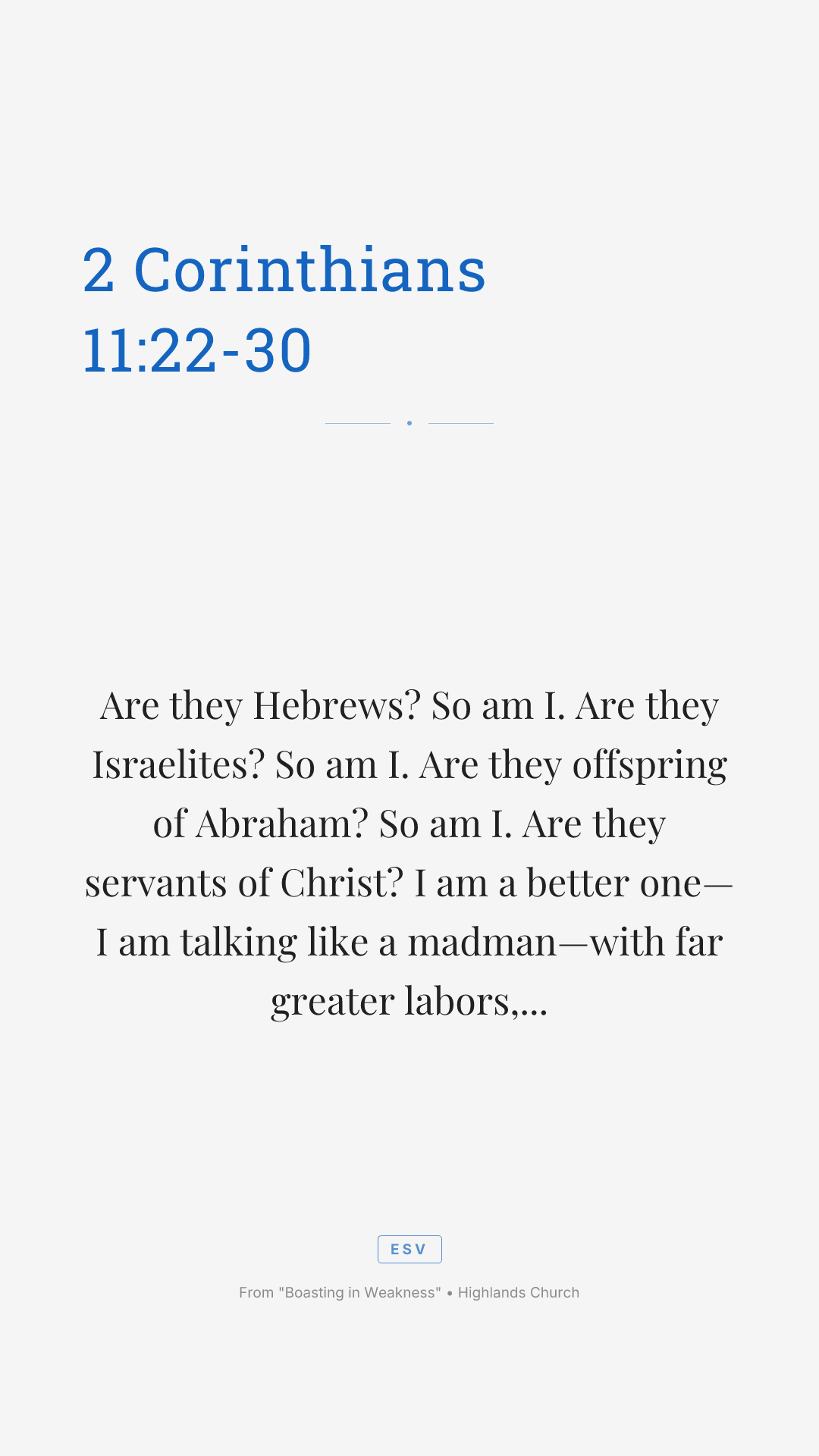
So in chapter 11, he talks about his experience physically as an apostle of Jesus. I'll rewind. I'll go to, uh, verse 22, Paul speaking of who he is. This is second Corinthians 11. He said, Paul. Paul. He says, are they Hebrews? These so -called super apostles. So am I, are they Israelites? So am I, are they offspring of Abraham? So am I, are they servants of Christ? I love this one. Paul says, I'm a better one.
Paul Would Only Be Truthful if Boasting in His Story
And then he says, I'm talking like a mad man with far greater labors, far more imprisonments with countless beatings and often near death. Five times I received at the hands of the Jews, the 40 lashes less one, three times I was beaten with rods. Once I was. I was stoned three times. I was shipwrecked a day and a night. I was a drift at sea on frequent journeys and danger from rivers, danger from robbers, danger from my own people, danger from Gentiles, danger in the city, danger in the wilderness, danger at sea, danger from false brothers in toil and hardship through many a sleepless night and hunger and thirst often without food and cold and exposure.
And apart from all other things, there's the daily pressure on me of my anxiety for all the churches who was weak. And I am not weak. Who is made to fall. And I am not indignant. If I must boast, I will boast of all the things that show my weakness. Paul says, you want to talk about street cred.
You want to talk about reasons of why you should listen to someone says Paul says, if that matters to you that much, listen to this. I must go on boasting, though there's nothing to be gained by it. I will go on divisions and revelations of the Lord. He says, you think those things were impressive? Let me talk about something even cooler. Than that. Not just physical experiences, but spiritual experiences. I must go on to visions of the Lord and revelations of the Lord.
Receive God's Protection Through Suffering
Verse two, he says, I know a man in Christ who 14 years ago was caught up to the third heaven. You ever sit in a small group and you get to the end of your small group time. It's prayer request time, right? Small group supposed to be out in five minutes, but then it's prayer request time. So you go an hour longer than you're intended to. Right? Okay. And it comes around to whoever, and it's their turn to offer a prayer request. And they start their prayer request with, so I have this friend. And in your head, you're like, are you talking about you?
You don't talking about, are you, are you just, you don't want to say it's you. So you're talking, you know, I have this friend, um, people speculate. Maybe this is what Paul's doing here. He talks about a man in Christ who had visions, a man in Christ who had revelations 14 years ago.
Some say, they think it's actually Paul who had this revelation. If you go to Galatians chapter one, you see that Paul did have a revelation from Jesus. That Paul spent three years of his ministry before he ever went and talked and ministered to anyone may have been discipled directly by Jesus.
That'd be a pretty sweet discipleship program. Wouldn't it? Paul says, I know this man, it might be himself who 14 years ago was caught up to the third heaven. Third heaven. What is that? Um, some say, man, the third heavens, if there's, you know, super apostles, super apostles go to second heaven, super duper apostles go to third heavens. There's like these layers of heavens that you get access to based upon. I don't think it's that if you look at the scriptures, the way they talk about heavens, think of the Psalms, the skies, declare the glory of God. The heavens declare your handiwork. When you look through the scriptures, the first heavens is like the sky.
It's like the thing right above us. It's the sky outside of the sky. Yeah. You have the stars that's oftentimes referred to as like the heavens, the second heavens. The third heavens then would be the place where God dwells. So Paul says, I know this man who had a revelation, who was caught up, whether in the body or not, I'm not sure it was this an out of body experience. Was this God actually like transported this dude to his presence? Um, Paul himself even says, I'm not entirely sure, but God knows.
And I know that this man was caught up into paradise. Is that a different. No, I think it's the same place. He's just proving the point. Think of Jesus when he's crucified thief on the cross, the thief on the cross professes faith in Christ. What does Jesus say to the thief? I tell you, surely this day you will be with me. Where in paradise, this is the presence of where God is.
So Paul says, you think the street cred is cool from all this physical stuff. Let me tell you about something even more extraordinary, a spiritual vision where maybe him, maybe a friend was caught up. up. To the actual presence of the Lord. You should listen to what I have to say because of these experiences.
I love this phrase. And he heard things. What do you hear? Well, things that cannot be told. That's a bummer, which man may not utter. Imagine if, you know, the apostle John has revelation from God, which is the last book of our Bible. What if he kept that to himself? That'd be a bummer, but for whatever reason, that's the will of the Lord here. What God revealed. To Paul's friend or what God revealed to Paul himself wasn't intended to be known by everyone. It's just for him on behalf of this man. I'll boast, but on my own behalf, I will not post except of my weaknesses, though. If I should wish to boast, I wouldn't be a fool.
Why? For I would be speaking the truth. Paul says, if I told you my whole story, I wouldn't be bragging. I would just be telling you my story.
Paul says, my life has been so extraordinary that I wouldn't be bragging. I wouldn't be boasting. I wouldn't be lying to you. you. I would just be giving you my testimony. So he did that in second Corinthians 11. He talked about all the sufferings. There's another story he tells in Philippians chapter three, beginning in verse three, talking about his pedigree, his accomplishments. He says this to the church in Philippi, for we are the circumcision, God's people who worship by the spirit of God and glory in Christ Jesus and put no confidence in the flesh. That's what we shouldn't do. We should never put confidence in the flesh. Our boast is to be a testimony to the Lord.
To be a testimony to the Lord. Our boast isn't in us. Our boast is in God. Our boast isn't in self. Our boast is in the son of God. Our confidence isn't in what we can do and what we can say. Our confidence is who Christ is and what Christ has done. No confidence in the flesh.
Paul says, though, I have myself a reason for confidence in the flesh. If anyone else thinks he has reason for confidence in the flesh, I have more. Circumcised on the eighth day. This is his way of saying, like, I've been a Christian my whole life. You've heard this phrase before. Like, I can never remember a time in my life I wasn't a Christian. That's like Paul's story. I was circumcised on the eighth day. From the moment I was born, I've been raised in the household of God's people, of
The Mystery of Paul's Thorn
The people of Israel. I was of the tribe of Benjamin. I was a Hebrew of Hebrews as to the law, as a Pharisee, as a teacher, as to zeal, a persecutor of the church, as to righteousness under the law, blameless. But whatever gain I have.
I've been put to death. I have been so that people will think more of us so we'd feel more lovely if we feel more lovely maybe we're more lovable and then the people around us will love us more i don't feel accepted by the people around me therefore if i inflate my ego or say all these awesome things maybe
I can make them think or feel differently about me and they too will accept me i don't feel like i belong in this group of friends therefore i inflate things i boast i brag i put confidence in myself so that others might think more highly of me and then maybe i can belong to we boast we brag but paul says i'm not going to do any of that i'm just going to let my life speak for itself each and every one of us deal with this temptation to boast this temptation to brag this temptation of pride it's natural it's natural in the church in corinth that's natural in our life today first john chapter 2 verses
15 through 17 say this from 1 John chapter 2 verses 15 through 17 say this don't love the world or the things in the world if anyone loves the world the love of the father is not in him for all that is in the world the desires of the flesh the desires of the eyes and the pride of life is not from the father but is from the world and the world is passing away along with its desires but whoever does the will of god abides forever friends we have no reason to boast if we will boast we boast in christ we have no reason to prove ourselves we have no reason to seek the power of his holy name in his name we are attached w power of his holy name in his name we
1 John 2:15-17 21:06"Do not love the world or the things in the world. If anyone loves the world, the love of the Father is not in him. For all that is in the world—the desires of the flesh and the desires of the eyes and pride of life—is not from the Father but is from the world. And the world is passing away along with its desires, but whoever does the will of God abides forever."
Respond to Pain with Prayer and Trust
Are attached w to gain God's approval, to seek to gain belonging from God, to seek God's love, we haven't earned it. But God demonstrated his love for us in this while we were still what?? Sinners. Mess -ups. While we were still sinners. Not because we were lovely. It's not because we were lovable. Christ died to make us lovely.
It's not because we were accepted. It's not because we were acceptable. If we boast, we boast in Christ for who he is and what he's done. We need to recognize our temptation to pride. Second thing, we need to receive God's protection from our pride through pain. That's what the apostle Paul does here. Verse 7. So to keep me from becoming conceited. I like to think of this phrase like this. Imagine someone's head just slowly swelling like a balloon until it pops.
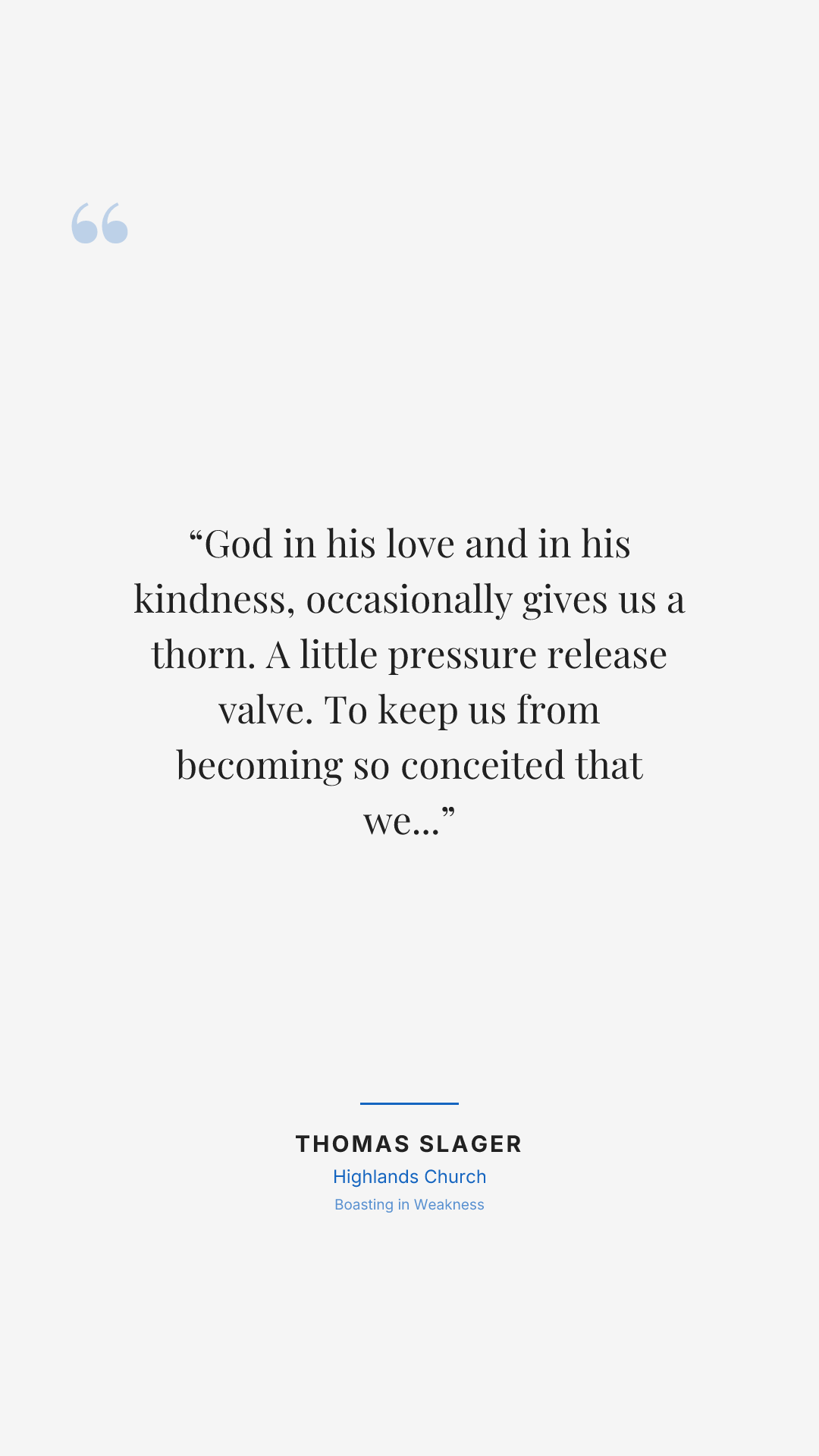
God in his love and in his kindness, occasionally gives us a thorn. A little pressure release valve. To keep us from becoming so conceited that we ruin our own lives. To keep me from becoming conceited because of the surpassing greatness of the revelations. A thorn was given me in the flesh. A messenger of Satan to harass me. To keep me from becoming conceited. There's five things we do know about this thorn and there's a whole lot of things we don't know about this thorn. Mainly, what the thorn even was.
First, some things we know about the thorn. The thorn, what's implied is that it's given by God. That because God loves the apostle Paul and doesn't want Paul to become conceited, God steps in and gives him a thorn. Here's what we also know to be true. Simultaneously, this thorn that was given by God is a messenger of who? Satan. Well, now I'm confused.
Who did it? The thorns given by God. Who did it? Satan. Well, now I'm confused. Who did it? The thorns given by God. Who did it? But the thorn's a messenger of Satan. How do those things completely work together? I think of Job chapter one. Somehow, Satan himself gains an audience with God and God asks Satan, hey, where have you been? What have you been up to? This is my paraphrase, so chill. Where have you been? What have you been up to? And the devil says to God, you know, I've just been searching the world looking for someone to destroy.
And this is one of, I think, the worst, my take, worst lines in the whole Bible. Because God says, oh, really? Have you considered my servant Job?
Well, who did it? Because God tells Satan, okay, you can have whatever you want. You just can't touch him. Free reign. Well, who's, how does that?
God is sovereign over all of it, but clearly the devil's there like messing stuff up.
So it is with this. God gives a thorn, but the thorn's simultaneously a messenger of Satan. How do these whole things work? I think it's a beautiful thing. I think it's a beautiful thing. I think it's a beautiful reminder to each of us, even when we're experiencing pain, when we're experiencing trial, when we're experiencing tragedy, even those things happen under the umbrella of the sovereignty of a good and holy, gracious, kind, and loving Father who's in control of all things.
Amen? So yes, the thorn given by God, messenger of Satan. He says the thorn is in the flesh. Some say because it's in the flesh, it's more of a physical thing. It's an ailment or a disability or who knows what it might be. Not just this emotional thing, but a very clear physical thing that he may have struggled with.
It's in the flesh. Fourth, it says it harassed Paul. The word harassed means punched, physically dragged him down. And then fifthly, it said this thorn was given him by God, messenger of Satan in the flesh to harass Paul for the purpose of keeping him from becoming conceited. The thorn was a gift.
There's things we do know about the thorn. What do we not know about the thorn? We know what the thorn is. Some speculate maybe it's temptation. It's some temptation that Paul constantly struggled with. Think of Romans chapter 7. God, the things I don't want to do are the things I keep on doing. And the things I want to do, these are the things I can't do. Who can save me from this body of death? Thanks be to God through Jesus Christ our Lord. Maybe this thorn, this temptation in his life was the thing that kept dragging him and driving him right back to the feet of Jesus. Perhaps. Some speculate maybe it's just the sufferings of Paul.
We read 2 Corinthians 11. He suffered a lot. Acts chapter 9, when Paul meets Jesus and is converted essentially to Christianity, God makes this statement. I will show him how much he must suffer for my name. Some say it's a physical thing. Some speculate Paul had bad eyes. That's why he had other people write some of his letters for him. He even says to the church in Galatia in chapter 3, maybe give me your eyes.
Some say Paul was a bad speaker. Wouldn't that be a bummer? If you were God's mouthpiece planting churches all over the world and you didn't talk good? Kind of like Moses though, isn't it? 1 Corinthians chapter 3, Paul says, when I came to you, I didn't come in plausible words of wisdom. I just came preaching Jesus. That's it. Wasn't trying to turn a pretty phrase. Wasn't trying to be cutesy. Didn't have perfect alliteration. All of his points didn't start with P like mine do this morning.
No, I just came preaching Jesus. 2 Corinthians chapter 10, people speaking of Paul, they say his letters are weighty and strong. His bodily presence is weak and Paul's speech, it's of no account. Maybe the guy's just not a good communicator. Chapter 11 verse 6, Paul confesses himself, even if I am unskilled in speaking.
Interesting that maybe the thorn God gave Paul was not a good public communicator, which is weird because he did a lot of that.
But then if he showed up and was just faithful, he can't boast himself anyways because he knows he's not good at the thing he's doing in the first place. If something happens, it's only because God showed up and did the thing. I mean, that's something as a preacher I've learned in some deep, meaningful ways.
Everyone who gives sermons frequently occasionally has a bad sermon. It just happens. And you go home all upset and you're like, that was bad, and then you get some emails Monday morning about how God showed up in deep, meaningful ways in the lives of people, and you know it wasn't you.
God's Sufficiency and Boasting in Weakness
I had a lady send an email to the church just a couple weeks ago, just so thankful how God used the text we were preaching through to restore her marriage, to get their eyes back on Jesus. We didn't even preach on marriage that morning at all. Who gets credit, who gets glory, who do we boast in? It's God, why? Because God's the one who did the thing.
God's the one who brings out transformation. God's the one who brings life change, and when he does that, he's the one who gets the glory because we can't change lives even if we tried.
How does Paul respond to pray? That's the third thing. Paul responds to pain with prayer. I think it's a valuable lesson for each of us as well. When we encounter trials of various kinds, certainly we should consider them joy because we know God is doing something in our life, but we also should bring them before the Lord and pray about them.
Look for wisdom and insight and counsel. God, is this a thorn? Is this something you're putting in my life to take my eyes off myself? Is this something you're allowing in my life to humble me because you don't want me to become conceited? Is this a thorn or is this something else?
God tells us to pray all throughout the scriptures. This is where Paul stops and pray three times. We have repetition. I don't think this passage is intended, to teach us how to pray, but there's a nice little model of prayer baked into here to verse eight. Three times, repeatedly, I pleaded. You have passion. Three times he passionately came before the Lord and with great clarity and specificity prayed what? That it should leave me.
God, three times I came to you and said, God, please will you take this from me? Please will you take this from me? I'm pleading with you. Will you take this from me? I think that's Paul's way of trying to figure out, hey, is this? Is this a thorn?
Is this something God's placed in my life to humble me? Or is this the kind of thing like we go to the Lord and pray for him to remove it and he will? First Thessalonians five, we're told to rejoice always. We're told to pray without ceasing. We're told to give thanks in all circumstances.
James chapter five, specifically in regard to suffering and being sick, we're told to pray. James five, verse 13. Is anyone among you suffering? Let him pray. Is anyone cheerful? Sing songs of praise. Is anyone among you sick? Let him call for the elders of the church and let them pray over him, anointing him with oil in the name of the Lord. So when we encounter pain, I think we have to wrestle and bring it before the Lord and ask him, hey, is this something you're doing in my life right now for my own humility?
James 5:13-14 31:15"Is anyone among you suffering? Let him pray. Is anyone cheerful? Let him sing praise. Is anyone among you sick? Let him call for the elders of the church, and let them pray over him, anointing him with oil in the name of the Lord."
Are you driving me to a place of weakness, driving me to a place of dependence, so that I've got to rely more fully on you?
We come before him, we plead with him and we pray for clarity. Maybe we'll get an answer like God answers Paul in verse nine. But God said to him, my grace is sufficient for you, for my power is made perfect in weakness. My grace is enough. Do we believe that? We sang it this morning. Your grace is enough.
Your grace is enough. Man, if we can come to that place and in humility say, God, your grace, the gifts I don't deserve from you, that's more than enough. I don't need anything else. I don't need to boast in self. I just boast in Christ for who he is.
There's a fourth thing. We rejoice in God's power rather than our own. Therefore, I will boast all the more gladly of my weaknesses so that the power of Christ may rest upon me. For the sake of Christ, then, I'm content with weaknesses. He doesn't say, I enjoy them.
He doesn't say, for the sake of Christ, then, man, I love it when people insult me. For the sake of Christ, man, I love persecution and calamity. Yippee. No, but he knows God is sovereign in all things. Even the trials, even the tragedies, even the valleys, the mountaintops, the thorns.
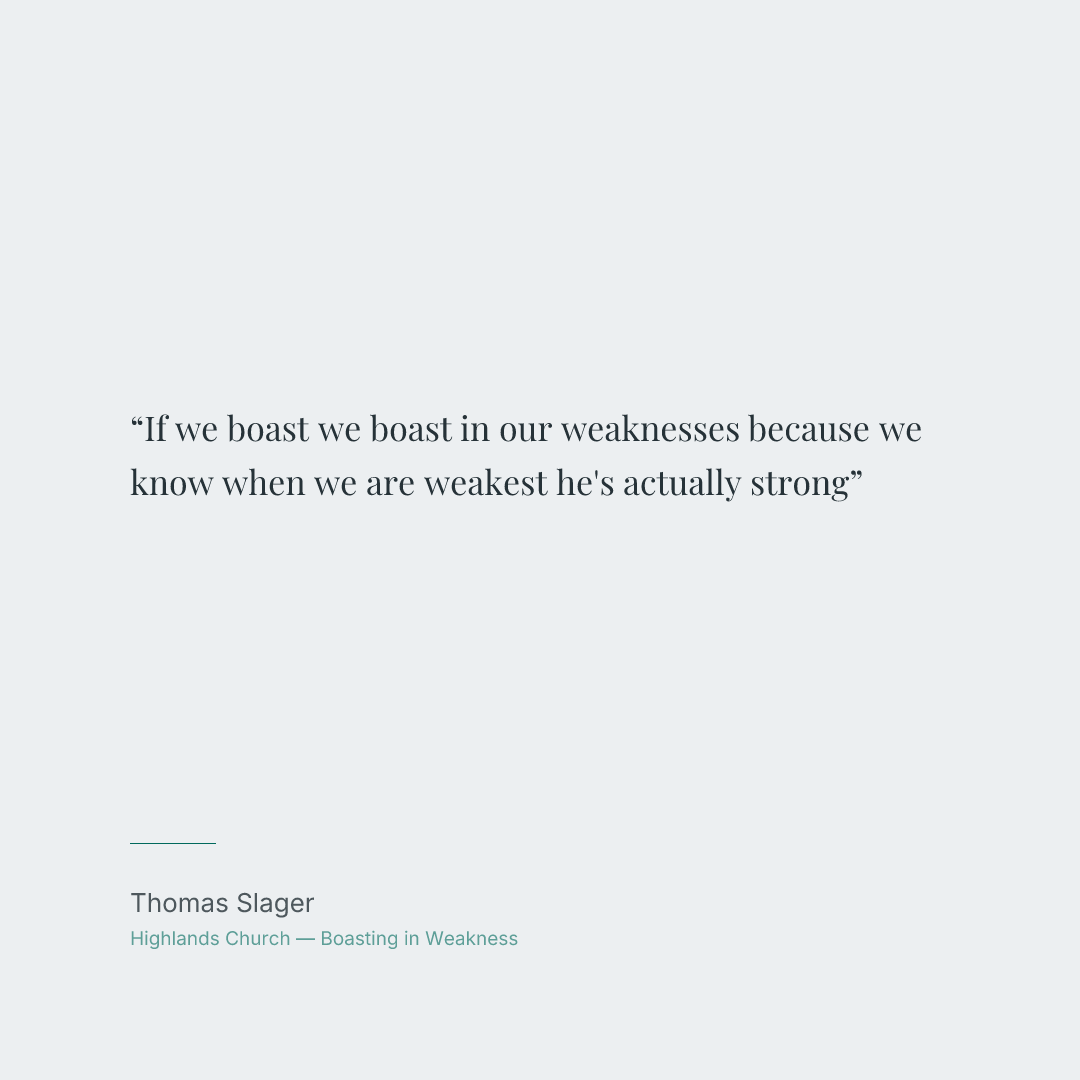
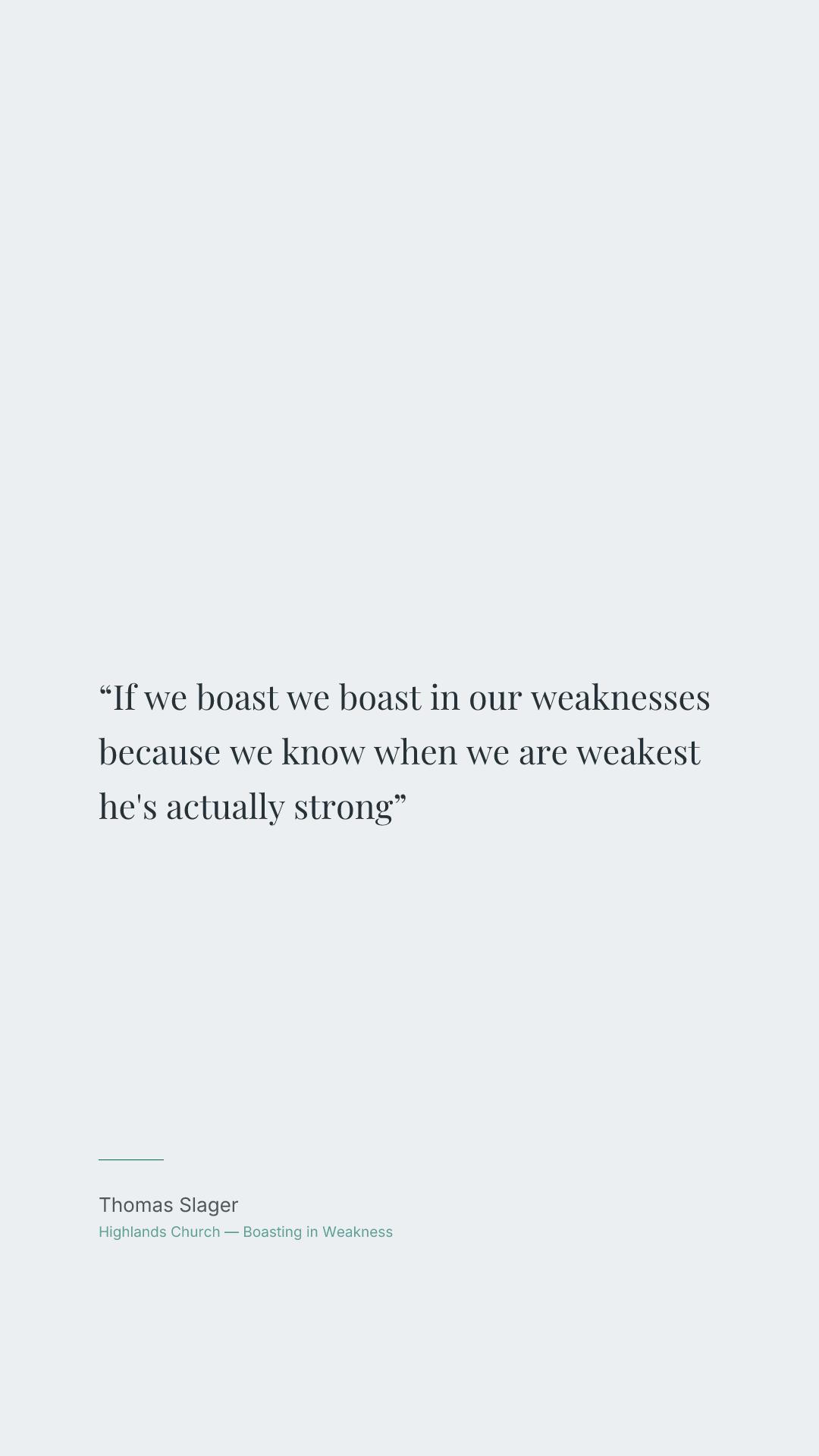
So regardless of what's going on, he's learned contentment in his weakness, in his insults, in his value, hardships persecutions and calamities why for when I'm weak then I'm strong friends if we're gonna boast let it not be in our strengths because the strengths the accomplishments we can't boast in any of that why because those were given to us by God to begin with so if we boast we boast in God if we boast we boast in our weaknesses because we know when we are weakest he's actually strong it's through Paul's sufferings maybe it's through Paul's inability to speak well whatever it is through the thorn that God gave him the weakness that God gave him Christ was most magnified and
Let me encourage us would we take these four things to heart would we recognize our temptation to pride would we recognize our temptation to put ourselves up on that throne to talk about how great we are would we repent of those things when God does something in our life would we receive that with gladness knowing that God is sovereign over all things will be respond to those painful circumstances with prayer maybe find wisdom and clarity God is this a thorn or is this something you might remove and then finally if we rejoice and we boast friends let it be true of us let it be true of this church if we boast we boast in Jesus amen let me pray
Let me pray let me me pray let me pray let me pray let me pray let me pray me pray let me pray let me pray let me pray let me pray pray let
Me pray let me pray let me pray let me pray let me pray let me pray let
Me pray let me pray let pray let me pray let me pray let me pray let me pray let me pray let me pray
Let me pray pray let me pray god if we boast would we boast in the areas where we're weak because we know it's in our weakness that you show your strength god
I pray for my friends in this space this morning who are going through pain who are going through trial who are going through suffering father i pray you is the god of all comfort would you comfort them in their time of affliction father
Would you see how they how you are working in their situation and would you remind each and every one of us what you say in romans 8 28 that you work all things for good of those who love you and have been called according your purposes god we hold fast to those promises this morning knowing that you're sovereign that you're good that you're gracious that you're kind that you love us so we submit to you we boast in you it's in your name we pray amen oh god how we need you friends we're gonna have some a prayer team down front uh right here right now they would love to pray with you maybe that's your heart oh god how i need you maybe that's a prayer that you need to profess to him this morning maybe it's because you're trying
Referenced Scriptures
Major Points
Recognize our natural temptation to pride — we boast to feel loved, accepted, and like we belong, but everything we have is a gift from God.
Receive God's protection from pride through pain — the thorn in the flesh is a gift from God to keep us from becoming conceited.
Respond to pain with prayer — bring trials before the Lord with passion, repetition, and specificity, seeking wisdom on whether God is using them for humility.
Rejoice in God's power rather than our own — when we are weak, then we are strong, because Christ's power rests on us in our weakness.
Discussion Questions
- 1
Pastor Slager talked about how our desire to boast is rooted in wanting to be loved, accepted, and to belong. How does the gospel address each of those three needs in ways that boasting never can?
- 2
Paul lists his impressive credentials and sufferings in 2 Corinthians 11, then says he'd rather boast in his weaknesses. Why do you think it was important for Paul to list those credentials first before redirecting the Corinthians' attention to weakness?
- 3
Pastor Slager pointed out that the thorn was simultaneously given by God and described as a 'messenger of Satan.' How does that dual reality shape the way you think about painful circumstances in your own life?
- 4
Paul prayed three times for the thorn to be removed, and God's answer was 'My grace is sufficient for you.' Have you ever had an experience where God's answer to your prayer was essentially 'no, but I'm enough'? How did you respond?
- 5
Pastor Slager said that when Paul may have been a poor speaker, any fruit from his ministry could only be credited to God. How might our own weaknesses and limitations actually position us to see God work more clearly than our strengths do?
Word Studies
A pointed stake or sharp splinter driven into the flesh, conveying persistent, piercing pain rather than a minor irritation.
2 Corinthians 12:7 — “...a thorn was given me in the flesh, a messenger of Satan...”
To strike with the fist, buffet, or beat repeatedly, implying ongoing, aggressive physical assault rather than mild annoyance.
2 Corinthians 12:7 — “...a messenger of Satan to harass me...”
To bring to completion or full realization, indicating that divine power reaches its ultimate expression and fulfillment precisely in human frailty.
2 Corinthians 12:9 — “...for my power is made perfect in weakness...”
This Week's Reading Plan
Go deeper this week with the passages from this sermon.
Read 2 Corinthians 12 for the full context
What stands out to you in this passage? How does it connect to the sermon?
Read 2 Corinthians 11 for the full context
Is there a promise, command, or truth here that applies to your life this week?
Read Philippians 3 for the full context
How does this passage shape the way you see God's character?
Read 1 John 2 for the full context
What would change in your daily life if you took this passage seriously?
Read James 5 for the full context
As you finish the week, what one truth from this series of readings will you carry forward?
Cross References
God deliberately reduced Gideon's army so Israel could not boast that their own strength saved them—the same principle Paul articulates: God works through weakness so He alone receives glory.
Isaiah promises that God gives power to the faint and strength to the powerless, providing an Old Testament foundation for Paul's declaration that God's power is made perfect in weakness.
God commands that no one boast in wisdom, might, or riches, but only in knowing the Lord—the very principle Paul applies when he redirects the Corinthians' boasting from credentials to Christ.
Moses protested that he was not eloquent, yet God insisted He would be with his mouth—a direct parallel to the possibility that Paul's thorn was poor speaking ability, yet God used him powerfully.
The heroes of faith were described as those whose 'weakness was turned to strength,' demonstrating a consistent biblical pattern where God's power operates precisely through human limitation.
Further Reading
The Power of Weakness: Embracing the True Source of Strength
by Dan Schaeffer
Humility: True Greatness
by C.J. Mahaney
Paul: A Biography
by N.T. Wright