Behold the Lamb
Pastor Bob Wade teaches from John 1:19-34 that Jesus is the Lamb of God — our sacrifice, substitute, and salvation — and calls believers to respond with humility, worship, and surrender, because the cradle always leads to the cross.
Primary Verses
Beyond the Baby: The True Meaning of Christmas
The Christmas story isn't just about a baby born in a cave that people used as a stable. There's so much more.
It's also about who this baby was and why he came. See, the Christmas story is about sacrifice.
It's about God sending his only son. This son would come and be born to be the substitute that would die for the sins that you and I commit. See, the truth is, the
Cradle leads to the cross. It always points to the cross. One of the most important things that can happen at this point in our lives, at this point in our season of the year, at this point when we're just about ready to celebrate Christmas, is to remember that the cradle leads to the cross.
So that we might be thankful, that the world would have a different picture of Christmas because of the message that we would bring to them.
You are the King. You are the Lamb of God. Lord, our prayer is that we would decrease, and you would increase.
Thank you, Father, in Jesus' name. So here's the question. Would you take less of you if you could get more of Jesus,
And then put him on the throne of your life? And watch what happens. There's some people that are gonna be down here that would love to be able to pray with you, pray for you. If you'd like to begin that relationship with Christ, again, you could do that right now. You could do that this morning. If you'd like to come home, don't be ashamed. This is about decreasing and him increasing.
This is the time to do that. Start off Christmas. Start off Christmas right, and watch how God blesses it. God bless you. Love you all. Have a great day.
John's Question: Who Is This Man?
It's about how you and I respond to the coming of the King. In John chapter one, it gives us the story here about John introducing Jesus to us in the eyes of a different John, one whom the people called the baptizer. Let me show you the context here. In John chapter one, if you've got your Bible, you can follow along with me here. John chapter one, starting in verse 19, he says this,
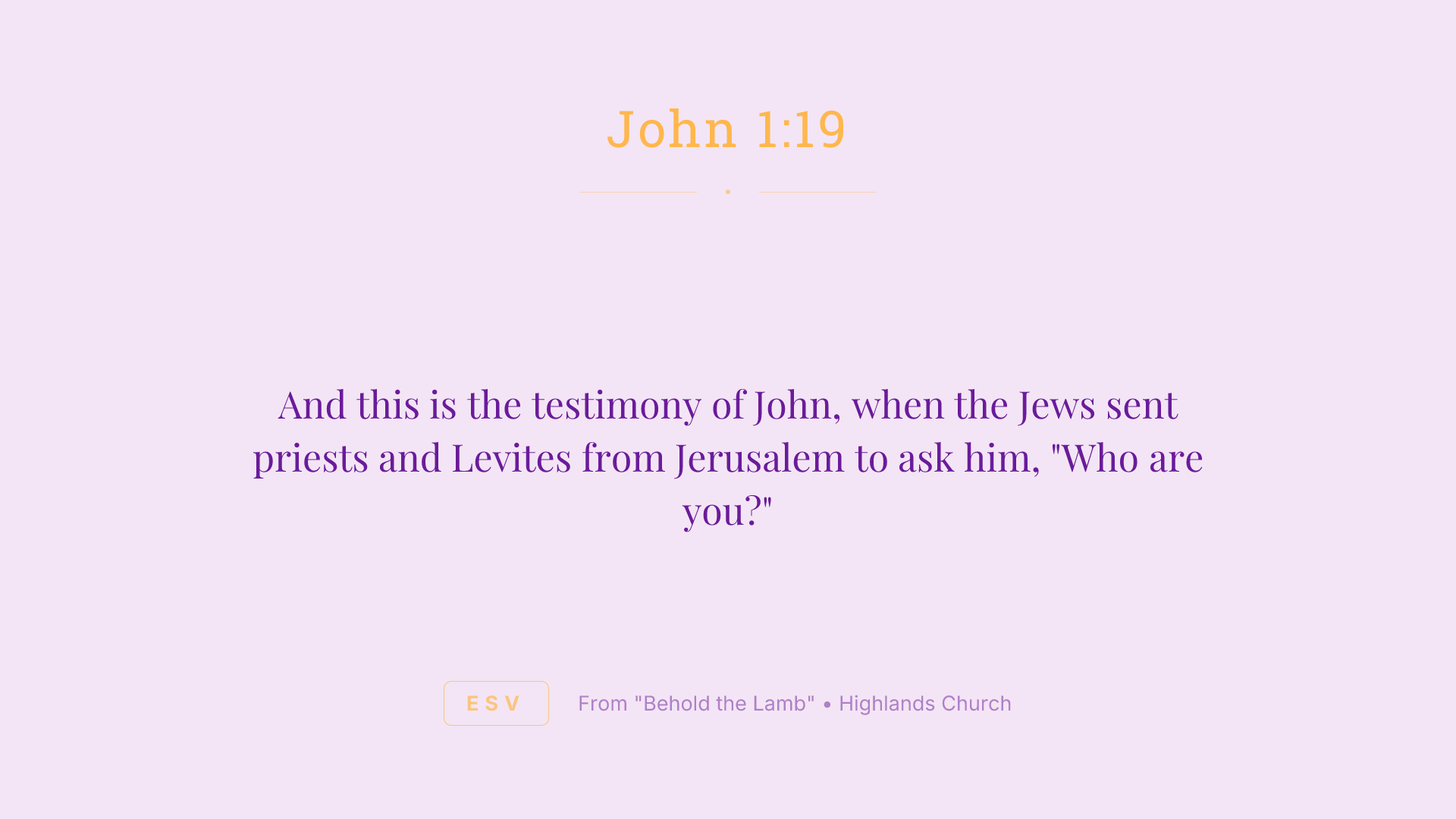
And this is the testimony of John. John, when the Jews sent priests, priests and Levites from Jerusalem to ask him, who are you?
John 1:19 2:00"And this is the testimony of John, when the Jews sent priests and Levites from Jerusalem to ask him, "Who are you?""
That kind of does set the important context here because see, the religious leaders in Jerusalem at that time, they've heard that something's going on in the desert.
And it's concerning enough that they've decided they're gonna send a group of people, a delegation to go and find out what is going on.
Bethany across the Jordan is not a place that was close to Jerusalem. If you're familiar at all with a map of Israel, you'll know that up in the north, there's this major body of water called the Sea of Galilee. And running down on one side over this, you're coming like this, is the Jordan River, which separates modern Jordan and Israel today. And then down at the bottom, you had the Dead Sea.
Well, Jerusalem, where they were at, where these religious leaders were at, is down at the very bottom there of Israel. And it's actually high up. It's 5 ,000 feet up. And to go down to where you can get to the Jordan, you had to go down about 5 ,000 feet. And then plus, like Jericho is 1 ,000 feet below sea level. So you had to go down even further into that. And then you had to travel up this long way. And then you had to cross over the Jordan River. And then you had to go up into, you know, know, an area there called Bethany.
To give you an idea, Bethany was probably about 40 miles from the Sea of Galilee, east of the Sea of Galilee. And it's a place that had become kind of an important place because it had good water. It had the very same water that the Sea of Galilee had in it because, you know, they both came from the same source. It came from Mount Hermon and it came down. And in those days, you know, you could look. And even today, if you look at a map, it just looks like the desert. But, you know, you can see, you know, that in those days, if you had water,
People were happy. They had life. They could take care of their animals. They were efficient. They could have something to drink. They could grow their crops. They could do whatever they needed to do. And so there were people there. And they hear that this guy, John, John the baptizer is there. And he's preaching and he's baptizing.
So they send people. This group of priests and Levites would have to travel. A long way. This wasn't an easy commute. This would be a journey that might last, you know, just to get there might be eight days.
You know, if you just hear like, oh, there's this guy that's a little bit of a rabble rouser. You know, you don't send a whole contingent of people. Something was happening there.
So the religious leaders, they go to get answers. Who exactly is this guy? What's he up to? What's his message? Why are the crowds flocking to him? I mean, these are people that, you know, they had families to take care of. They had places that they needed to be. They had animals to take care of. And, you know, all these different things in life that they had to sort of be responsible for. Are they just going to pack up and leave and go find this guy in the middle of nowhere?
John's Identity and His Purpose
It's a big deal. So they go to question him. Listen to verse 20 and 21.
They've asked him, who are you? Verse 20, he confessed and did not deny, but he confessed, I am not the Christ.
John 1:20 5:53"He confessed, and did not deny, but confessed, "I am not the Christ.""
So very clearly here, John wants to be clear. I'm not the Messiah. Don't come thinking that I'm saying that I'm not.
Verse 21, and they asked him, what then? Are you Elijah? Now that may not sound like a really big deal to you, but let me tell you why it's a little bit interesting. Why in the world would they ask this guy, hey, are you this prophet that died hundreds and hundreds of years ago?
John 1:21 6:11"And they asked him, "What then? Are you Elijah?" He said, "I am not." "Are you the Prophet?" And he answered, "No.""
Why would you ask that? Except for the fact that there's a prophecy in the book of Malachi, in Malachi chapter four. And the prophecy is the fact that one day, before God brings judgment and before the great and terrible day or the devastating day or awesome day, depending on what translation you read, but it all means the same thing.
Before that dreadful day of judgment comes, he'll send Elijah. And so it's almost like they're asking him, wait a minute, are you here to pronounce that final judgment is coming?
Nope. Again, John says, no, I'm not Elijah reincarnated. I'm not him. Okay then, well, so are you the prophet? The prophet meaning Moses, the prophet, the one that was responsible for the Pentateuch, the first five books of the Bible? Are you him? Nope. Not him. Now John knows who exactly he is. Look at verses 22 and 23. So they said to him, who are you? You need to give us an answer to this, and what do you say about yourself?
John 1:22-23 7:13"So they said to him, "Who are you? We need to give an answer to those who sent us. What do you say about yourself?" He said, "I am the voice of one crying out in the wilderness, 'Make straight the way of the Lord,' as the prophet Isaiah said.""
The Authority Question: Why Baptize?
Verse 23, I am the voice of one crying out in the wilderness. Make straight the way of the Lord, said the prophet Isaiah. So he is an idea. Now, you get to verses 24 and 25, the Pharisees are gonna push back a little bit. It says, now they had been sent from the Pharisees and they asked him, verse 25, then why are you baptizing?
John 1:24-25 7:52"(Now they had been sent from the Pharisees.) They asked him, "Then why are you baptizing, if you are neither the Christ, nor Elijah, nor the Prophet?""
If you are neither the Christ nor Elijah nor the prophet, why are you doing what you're doing?
I mean, if you're not one of those, I mean, strict Jewish tradition at that point was set that only Moses or the Messiah, Messiah himself could introduce new religious rituals.
John 1:26-27 8:28"John answered them, "I baptize with water, but among you stands one you do not know, even he who comes after me, the strap of whose sandal I am not worthy to untie.""
The Unworthy Servant and Ancient Hospitality
Listen to his response. Verse 26, John answered them, I baptize with water. But among you stands one you do not know. Even he who comes after me, the strap of whose sandals I am not worthy to untie. What he says here is very simple. He says my baptism is a simple thing, I'm preparing hearts. And I'm just making people ready. And John almost seems like he's surprised or shocked here in the middle of this. Like, why are they coming to ask me? Don't you realize that there's one among you that I'm not even worthy to untie his sandals?
Now, let me tell you what a big statement that really is. Because that sounds like something like, oh, okay, nice statement. No, in those days, when you saw somebody or somebody came to your home, before they would come into your house, somebody in your house would remove their sandals and wash their feet.
You say, well, why did they do that? Was that just like a nice thing to do? No, nobody had like nice floors. Nobody had carpets. Nobody had those types of things. People walked on dirt roads. Those roads, they had roads that were just filthy. They had dust everywhere. And by the way, all of the animals traveled on the very same roads. And you know what? They're not real polite. They didn't stop and go, hey, is it okay if we defecate right here? They defecate wherever they want to, right?
And when you came time to cook something to eat, it wasn't like they could run down to Fry's or Albertsons or something like that. I mean, you had to take an animal outside with like, if it was a chicken and you killed it right there. You didn't want to kill it inside. You didn't want to kill it inside your house and get all the blood and the junk and everything there. So you'd take it out on the road where everything else was bad and you'd kill it there and leave all of that there, which meant the roads were disgusting.
And people are walking around in this all day long. So when they came to your house, the lowest servant in the house would always be the one like, because they have to take that strap off. They have to tie it up They have to tie it up on their sandals and pull it off and clean that and then wash your feet.
And it was disgusting. You were thankful that if you got to rise up the ladder and not be the lowest one on the ladder. And yet here, in this particular case, John says, look, I'm not even worthy. There's one among you. I'm not even worthy to be the lowest servant here.
Behold the Lamb: The Most Defining Christmas Truth
Go to verses 29 here, because the next day, something amazing happens. It says, in these things, verse 28, took place in Bethany across the Jordan where John was baptizing. Verse 29, the next day he saw Jesus coming towards him and he said, behold the Lamb of God that takes away the sin of the world. What an amazing statement that is. In fact, in some ways it doesn't sound like it, but it's the most defining Christmas truth that's ever spoken.
John 1:28-29 11:39"These things took place in Bethany across the Jordan, where John was baptizing. The next day he saw Jesus coming toward him, and said, "Behold, the Lamb of God, who takes away the sin of the world!""
Behold the Lamb of God that takes away the sin of the world. Now, why call Jesus a lamb? The context here is super important. Every Jew would hear that and understand exactly what that meant, because the lamb meant different things. For example, the lamb meant sacrifice. When you saw a lamb, you thought to yourself, one day that lamb is going to be sacrificed. A sacrifice was something that was going to be sacrificed. that was going to be sacrificed. It was something that had to happen to cover up sin. And because they all understood Leviticus 17, it told us without the shedding of blood, there is no forgiveness of sins.
Jesus as Sacrifice, Substitute, and Salvation
They got that. They all understood what the Passover was all about from Exodus chapter 12. Remember the movie, The Ten Commandments? I mean, it's only been on about a thousand times in life, right? Remember the story?
Story is you would take a young male lamb without blemish, and you would kill it, and then you would take its blood, and then you would paint it across the doorposts of your house, and then when the angel of death would come, it would pass over you.
That's what the Passover was. So the lamb meant sacrifice. I'm missing God's judgment because of what the lamb has done. But the lamb also meant substitute. The substitute was the fact that even in the Old Testament, they would talk about a scapegoat being one that would have all the sin laid on them and blamed for sort of everything. And in a sense, not only was Jesus one that was the sacrifice, but he was also the substitute.
The blame for all sin was laid upon him. He would die in their place.
Isaiah 53 tells us that exactly what Jesus was born, he was born to do
Isaiah 53:4-5 14:36"Surely he has borne our griefs and carried our sorrows; yet we esteemed him stricken, smitten by God, and afflicted. But he was pierced for our transgressions; he was crushed for our iniquities; upon him was the chastisement that brought us peace, and with his wounds we are healed."
Listen to what it says here. Isaiah 53, listen to the first few verses of this. Verse four, he says, surely he has borne our griefs. By the way, if you underline in your Bible, and it's okay, because it's paper, you can do this, but I want you to underline the word our, okay? Just underline this and see if you can catch the meaning then of what about Isaiah 53 is all about. Surely he has borne our griefs and carried our sorrows.
Yet we esteemed him stricken and smitten by God and afflicted, but he was pierced for our transgressions. He was crushed for our iniquities. And upon him was the chastisement that brought us peace. He was the substitute. It should have been ours, but
He took it. It also brings us to the third truth about the lamb though, is it also meant salvation. You see, Isaiah 53 even continues with that a little bit when it says this, in verse five, he says, upon him was the chastisement that brought us peace, and with his wounds we are healed. Do you realize what he's saying there?
With his wounds? He wasn't just hurt. He wasn't just hurt a little bit No, with his death, we
Can be forgiven, healed, have new life, transformed, everything you've ever wanted. Right there, that's salvation. John is pointing to Jesus at this moment. Behold the lamb. Do you see it? He's our sacrifice. He's our substitute. He's our savior.
John's Witness: The Complete Picture of Jesus
This is the lamb, God's lamb, the final sacrifice. There never has to be another sacrifice again, ever.
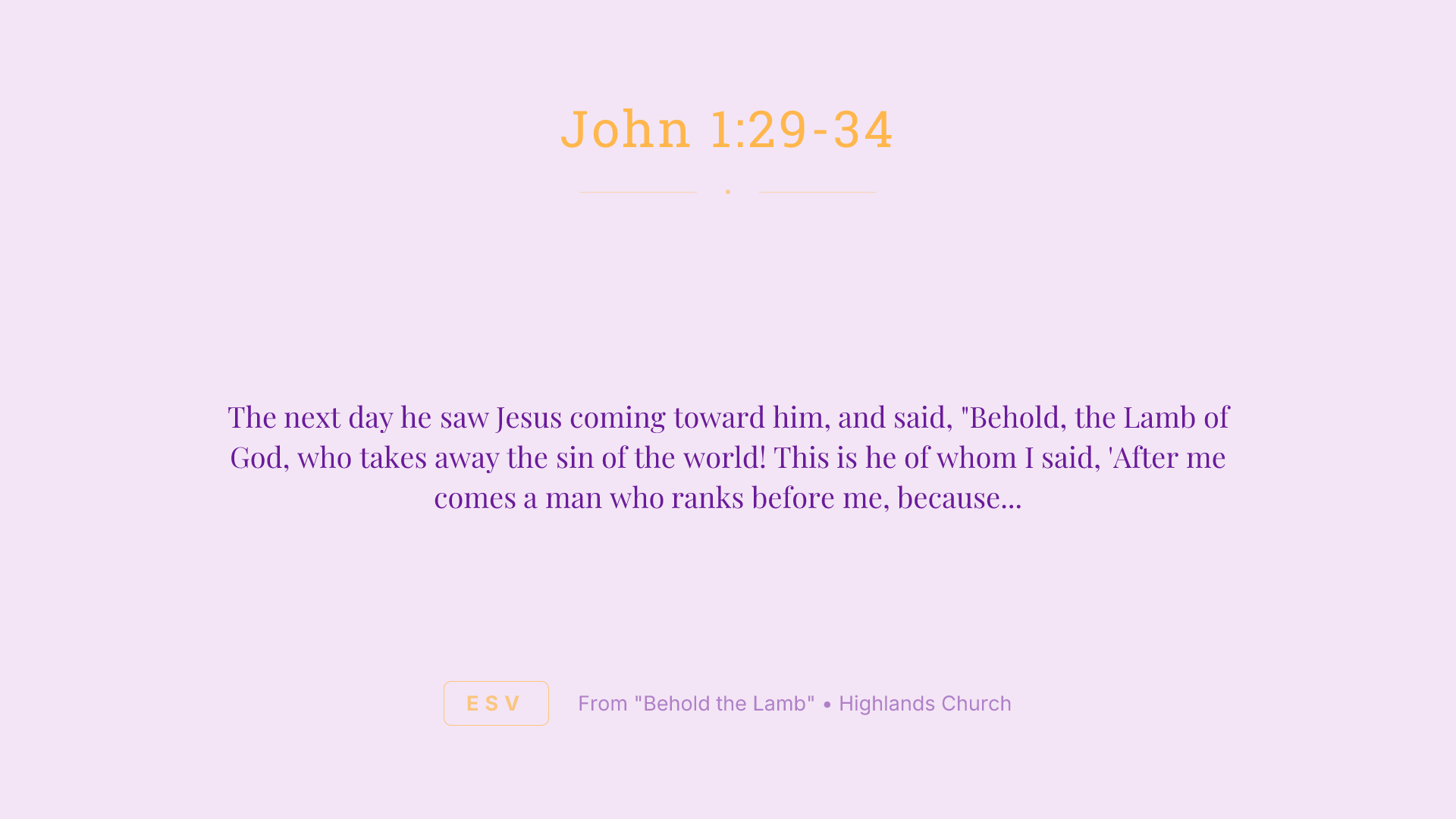
Now, John keeps going here, in John chapter one, starting in verse 29, let me read from that again, and then you can see all the different things he's now gonna say about Jesus. The next day he saw Jesus coming towards him, and he said, behold the lamb of God, who takes away your sin. He takes your sin. He takes away the sin of the world. This is he of whom I said, after me comes a man who ranks before me, because he was before me. I myself did not know him, but for this purpose, I came baptizing with water, that he might be revealed to Israel.
And John bore witness, and saw the spirit descending from heaven like a dove, and it remained on him. I myself did not know him, but he who sent me to be baptized with water said to me, he is one whom you see the Holy Spirit descend and remain. This is he who baptizes with the Holy Spirit. And I have seen and bore witness that this is the Son of God.
Religion Cannot Transform; Jesus Does
Realize what John has just told us about Jesus there. Not only is he the ultimate sacrifice, the lamb of God, but that God has actually showed him and put his blessing upon him.
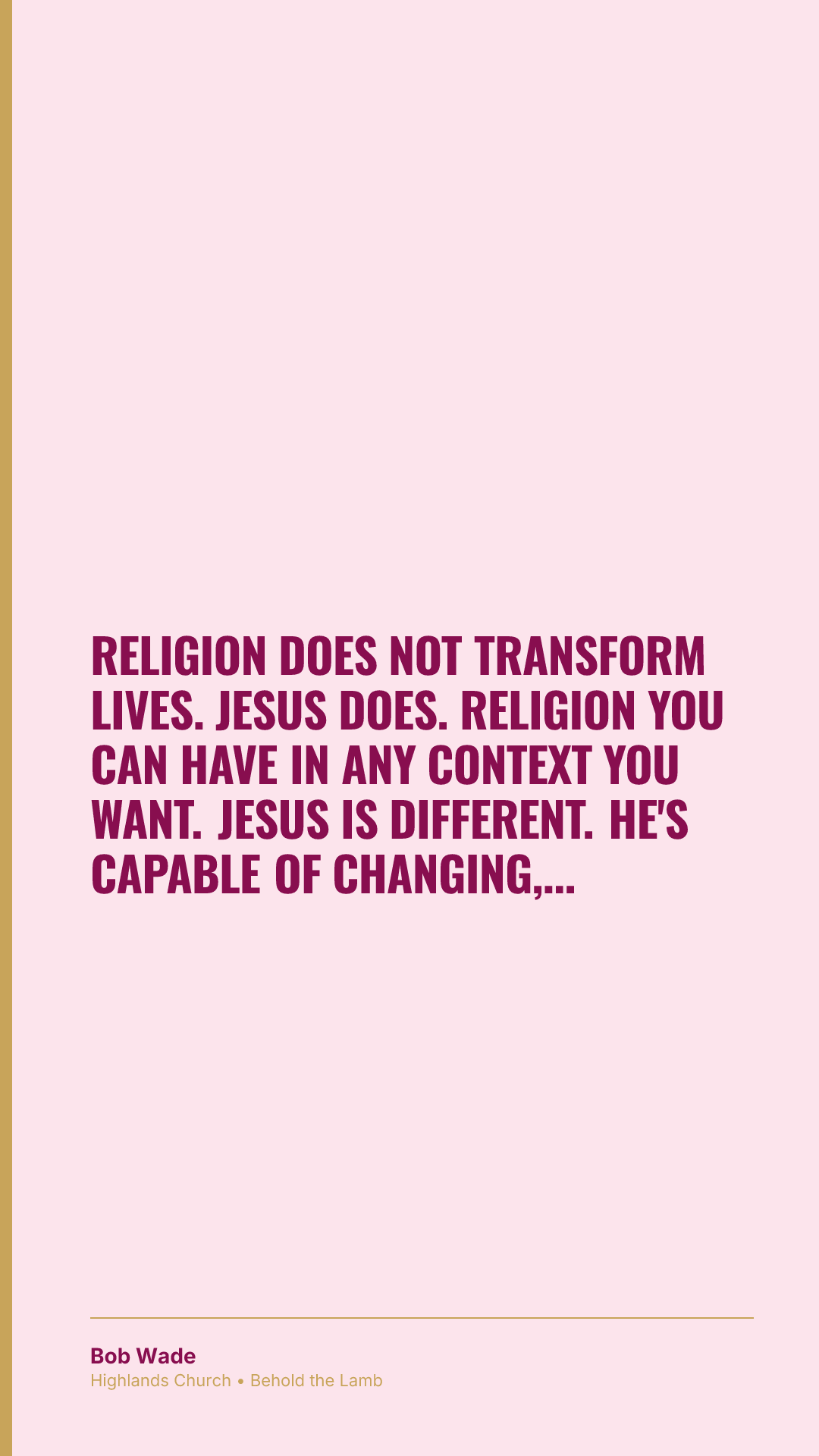
He will follow the Holy Spirit. He will baptize with fire. He's the giver of new life. He's the one that transforms lives. Religion does not transform lives. Jesus does. Religion you can have in any context you want. Jesus is different. He's capable of changing, transforming you. He's already decided to be the sacrifice for you.
He's already decided that he would be the substitute to death. He's already decided to take your blame.
John's Perfect Response: Decrease So He Increases
He's already committed to giving you a new life. The baby born in the manger of Luke two and Matthew chapter one was born to be the ultimate sacrifice, the ultimate substitute, the ultimate salvation. The cradle points to the cross.
By the way, this is why we give Christmas gifts to each other. Do you know that? Because at Christmas we celebrate God giving us the greatest gift that's ever imaginable. The question is how do we respond here to the Savior? I mean, John is gonna be the perfect example for this. He sees Jesus coming and he is going to respond the right way. His disciples don't know how to respond yet, but he'll tell them exactly how to do this and tell us, in fact, how to do this.
Transformation Through the Lamb: New Values and Relationships
Listen to what he says in John chapter three, starting in verse 22 through 23. 26 will kind of set the scenario here. He says, after this, Jesus and his disciples went into the Judean countryside. So, in other words, Jesus has crossed over, back over the Jordan River and he's actually in what we would call Israel today in Judea.
And he remained there with them and was baptized. John also was baptizing, but he's still on the other side. He's at Anon near Salem because water was plentiful there and people were coming and being baptized for John had not yet been baptized. But he had been put in prison. Now a discussion arose between some of John's disciples and a Jew over purification. And they came to John and they said, Rabbi, he was with you across the Jordan to whom you bore witness. Look, he is baptizing and all are going to him. Now I love what John does here because in verses 27 through 29, his response is absolutely amazing because his disciples have come to him and now they're going, wait.
What happened to what we were doing? I thought we were calling people to righteousness and now, you know, the people are all leaving and they're going over and following Jesus.
John 3:27-30 21:27"John answered, "A person cannot receive even one thing unless it is given him from heaven. You yourselves bear me witness, that I said, 'I am not the Christ, but I have been sent before him.' The one who has the bride is the bridegroom. The friend of the bridegroom, who stands and hears him, rejoices greatly at the bridegroom's voice. Therefore this joy of mine is now complete. He must increase, but I must decrease.""
John's response here is so right. Listen to what he said, 27. He says, John answered, a person can receive nothing, cannot receive even one thing unless it is given to him from heaven.
You bear, you yourselves bear me witness and I said, I am not the Christ. This is not about me, but I have been sent before him. The one who has the bride is the bridegroom. The friend of the bridegroom who stands and hears him rejoices greatly at the bridegroom's voice. Therefore, this joy of mine is now complete.
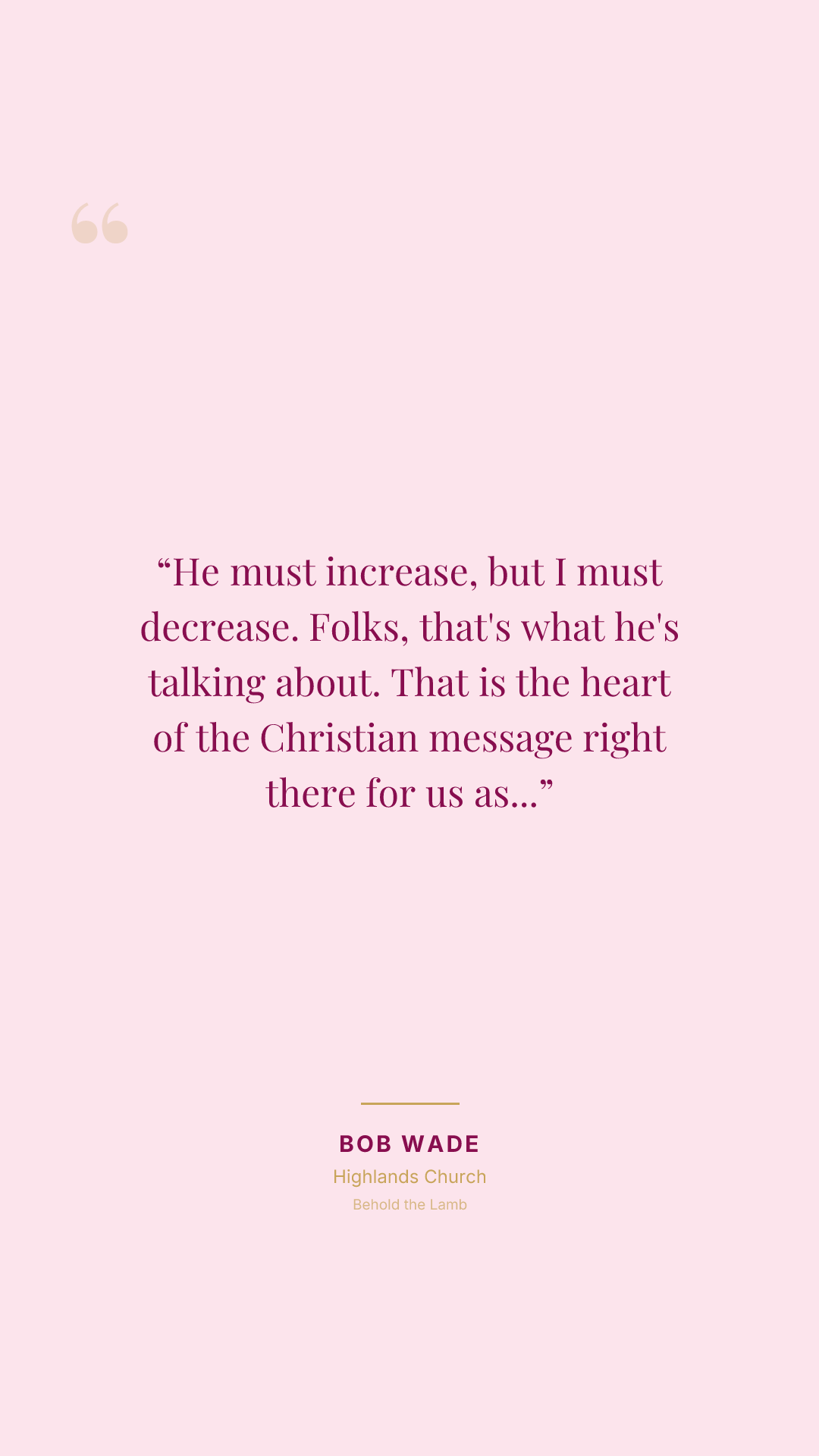
Listen to what he says then, he closes this so well. Verse 30, he must increase, but I must decrease. Folks, that's what he's talking about. That is the heart of the Christian message right there for us as Christians. The Christmas message is not me centered. It's about getting our hearts focused in, centered in on Jesus. The Christmas connection here is the cradle makes sense only because of the cross.
The baby, Jesus, the baby here born in the manger in that cave was born to be, born to become the lamb, the lamb of God. He was born so that one day he might be the sacrifice and act as a substitute and take our sin so that ultimately he would give us salvation.
The Call to Respond: Humility Over Self-Effort
Yes, Christmas is a lot of really wonderful things. It's wonderful to gather together as family and friends. It's wonderful to be able to sit down at a meal and laugh together. It's wonderful to be able to sit down at a meal and laugh together wonderful to be able to sit down at a meal and laugh together and enjoy that time. It's fun to decorate our homes and exchange gifts and plan a meal together and be festive and all those kinds of things. But first and foremost, it's about preparing our hearts to honor the lamb of God.
I'm gonna ask the worship team if they'll come back and join me. Christmas reminds us that Jesus is the life giver to
All who would receive him. He's the lamb, the ultimate sacrifice, the one who transforms lives.
That he came to take our sin, to be our substitute. He came so that you and I could be forgiven,
Redeemed, restored, transformed. And transformation, it changes us. It begins to change my values. That I'm not focused in completely on me. It's not about me.
It begins to change my relationships and how I look at things. It changes forgiveness. I can't tell you how many people I've heard say, well, I've got this one broken relationships and it just seems like it's never gonna be healed and I just can't bring myself to forgive them. You know what, God can forgive you, you can forgive them.
Take them off your hook, put them on God's, forgive them. It changes our priorities. It changes our mission.
The lamb of God should also be a challenge to us in how you and I are gonna respond to him.
John's disciples didn't know how to respond to Jesus. John did. His response again in verse 30 was so clear. Behold the lamb of God who takes away the sin of the world. He says, he must increase, I must decrease. What you hear in that is deep humility, sincere worship, complete surrender.
If you've never done that, then you're missing out on this deep, incredible truth of Christmas.
That Jesus didn't stay in a cradle. He grew out of it, went ultimately to the cross again so that he could be, our
Sacrifice, our substitute, our salvation. The question is, how are we gonna respond to that? Will you allow that humility to come out in you?
Because that's the way we start Christmas. With a clear picture of who that baby, that born in a manger, would grow to be. Why he came. What was his message? What was he all about? Should have the most profound effect on us.
I'm praying that it will on you. You know, that there's a great promise in Romans chapter 10, verse 13 that says, whoever calls upon the name of the Lord will be saved.
Romans 10:13 27:35"For "everyone who calls on the name of the Lord will be saved.""
He's not asking you to come on some great, incredible journey to try to show how, you know, really worthy you are of him saving you. That's not the case. Years ago, my wife and I were in, you a church. know, a church. In Spain, in a place called Santiago de Compostela. And we noticed that people had started this walk that was like, it was 100 miles long. And it was their way of sort of showing, okay, yeah, I'm worthy of you saving me. And then the last mile, they actually got down on their hands and knees, and they did the last mile on their hands and knees, and it was gross. I mean, blood and everything, and all over the place.
They missed the point. Jesus has done all the work. He's asking you to recognize who he is, trust in him.
He's not asking you to crawl. He's asking you to humble yourself, recognize who he is. He is the King of Kings, the Lord of Lords. He is the Lamb of God sent to be that sacrifice. It's my prayer that if you've never made a decision to follow him, you do that right where you're at.
You don't need somebody else to do that for you. You can do that yourself. You can trust in Christ. You can ask him to forgive you, and to come in, and to take control of you, and dwell with you, and to be your Savior and Lord right where you're at.
Maybe you did that once before in your life, or a couple of times maybe even before, and somehow it seems like you've just sort of lost all of that, and just walked away, and maybe it wasn't even in time. Maybe it wasn't intentional, but you know what? Maybe then it's time for you to come home.
Just humble yourself before him. Would you pray with me? Father, I pray that, Lord, you would move
In the hearts of our people, those hearts that have kept you in the cradle.
Would you help them to see, Lord, that you became the Lamb that made sacrifice for them, that took their place. You've come to give them brand new life,
Referenced Scriptures
Major Points
The cradle leads to the cross — Christmas is fundamentally about sacrifice, not just celebration
Jesus is the Lamb of God, fulfilling the roles of sacrifice, substitute, and salvation
Isaiah 53 reveals that Jesus bore our griefs, was pierced for our transgressions, and took our punishment as our substitute
Our response to the Lamb must be humility, worship, and surrender — He must increase, I must decrease
Discussion Questions
- 1
Pastor Wade emphasized that 'the cradle leads to the cross.' How does keeping this connection in mind change the way you personally experience the Christmas season compared to how our culture typically celebrates it?
- 2
When John the Baptist said he wasn't even worthy to untie Jesus' sandals — and Pastor Wade explained just how degrading that task was — what does that level of humility tell us about how John understood his own identity in relation to Jesus?
- 3
Pastor Wade pointed out three things the lamb represented to every Jewish listener: sacrifice, substitute, and salvation. Which of these three aspects of what Jesus did is most meaningful to you right now in your life, and why?
- 4
John's disciples were troubled that people were leaving them to follow Jesus, but John responded with 'He must increase, but I must decrease.' Where in your own life do you find it hardest to let go of your own agenda and let Jesus take the lead?
- 5
Pastor Wade shared the story of pilgrims in Santiago de Compostela crawling on their knees to prove their worthiness. How do we sometimes fall into a similar mindset of trying to earn God's grace rather than simply receiving the gift of the Lamb?
Word Studies
A young lamb specifically associated with sacrificial offering, distinct from other Greek words for sheep, emphasizing innocence and ritual sacrifice.
John 1:29 — “...Behold, the Lamb of God, who takes away the sin of the world!”
To lift up and carry away, implying both the bearing of a burden and its complete removal — not merely covering sin but taking it away entirely.
John 1:29 — “...the Lamb of God, who takes away the sin of the world!”
Discipline, correction, or chastening punishment endured for the purpose of instruction and restoration — here borne by another on behalf of the guilty.
Isaiah 53:5 — “...the chastisement for our peace was on him...”
This Week's Reading Plan
Go deeper this week with the passages from this sermon.
Read John 1 for the full context
What stands out to you in this passage? How does it connect to the sermon?
Read Isaiah 53 for the full context
Is there a promise, command, or truth here that applies to your life this week?
Read John 3 for the full context
How does this passage shape the way you see God's character?
Read Romans 10 for the full context
What would change in your daily life if you took this passage seriously?
Read Leviticus 17 for the full context
As you finish the week, what one truth from this series of readings will you carry forward?
Cross References
Abraham tells Isaac 'God will provide himself the lamb for a burnt offering,' foreshadowing God's own provision of Jesus as the ultimate sacrificial Lamb — the very concept John the Baptist announces in John 1:29.
Peter declares believers were redeemed 'with precious blood, as of a faultless and pure lamb, the blood of Christ,' connecting the Passover lamb imagery to the New Testament understanding of Christ's substitutionary death.
Contrasts the repeated Old Testament animal sacrifices with Christ's single, final sacrifice — reinforcing Pastor Wade's point that Jesus is 'the final sacrifice' and there never needs to be another.
Christ's self-emptying and humility unto death on a cross parallels John the Baptist's posture of 'He must increase, but I must decrease,' showing that humility is central to the gospel from both the Savior's and the servant's perspective.
The original prophecy John the Baptist quotes about himself — 'the voice of one crying in the wilderness' — providing the Old Testament foundation for his role as the forerunner who prepares hearts for the coming Lamb.
Further Reading
The Lamb of God: Seeing Jesus in Exodus, Leviticus, Numbers, and Deuteronomy
by Nancy Guthrie
The Cross of Christ
by John Stott
Gentle and Lowly: The Heart of Christ for Sinners and Sufferers
by Dane Ortlund