Death Lost Its Final Word
Through John 11 and Lazarus's death, Pastor McKeown teaches that death is inevitable but defeated by Christ, who is the resurrection and the life, offering eternal assurance to believers.
Primary Verses
The Reality of Death: From Chuck Norris to Scripture
Thank you, Krista. Thank you, Dorlis. I told Dorlis, Krista earlier, that song got me through some really dark times at college and just his eye is on the sparrow. He's watching after us. He cares for us. Turning your Bibles to John chapter 11. About this time last year, I began a series on the gospel of John. Went all the way through August. Got all the way through chapter 10 from March, April, May, June, July, and August. Finally got to chapter 10. We took a break from John. We're resuming that. We're going to go all the way through the end of the gospel. But as you're turning to your portion of scripture, I guess you know that this week our country lost a legendary.
Our legendary hero, Chuck Norris. Norris was a martial arts tough guy. Fought with Bruce Lee. Fought with Kwai Chang Kane of Kung Fu fame. Also most respectfully for a Texan, he played Texas Walker admirably. 2009, he accepted Jesus Christ as his Lord and Savior. But one of the things that about this week, week, one of the things about Chuck Norris was his legendary toughness. One statement was, Chuck Norris doesn't do push -ups. He pushes the earth down.
I surrender. All to him. I ask him. He did. Throughout the rest of the day. Say God this is my prayer to you. I surrender all. God bless you. Amen.
Death as a Defeated Enemy: Poetry and Promise
When Chuck Norris walks into a room, he doesn't turn off the lights. He turns the darkness off. Time waits for no man unless that man is Chuck Norris. When the boogeyman goes to bed, he turns the darkness off. He checks his closet for Chuck Norris.
Death, you're going to have to listen closely. Death once had a near Chuck Norris experience.
Ghosts, when they sit around the campfire, they tell stories about Chuck Norris. And only a few days before he died, he said this, I don't age, I level up.
We smile at those memes. I guess they're not memes. I don't know what you would call them. Chuck Norris, you'd call them facts.
Death came for Chuck Norris. As tough of a guy he is. And that's our story for today. This is the introduction to our story today. Death comes for all of us. There is no exceptions. Death is 100 % assured for each and every one of us. Only two people, not including Jesus, only two people in the Bible did not die. And those two,
Elijah and Enoch, they are theorized that they might come back in the end times. The book of Revelation says two witnesses will be upon the earth. Maybe those two witnesses are Enoch and Elijah because the Bible does say even Jesus died, he rose from the dead. John Donne, the poet, preacher from the 16th century, wrote about the same time as the King James was being originated. And the same time really as Shakespeare, using Shakespearean English.
The Context of Lazarus: Jesus at the Jordan
John Donne called death the grand leveler. The ultimate equalizer, we would say today. He famously wrote a poem which begins this way. No man is an island. How many of you have heard that? Well, you'll know certainly the way it ends. Each man is an island. an island. Each man's death diminishes me. For I am involved in mankind.
Therefore, sin not to know for whom the bell tolls. It tolls for thee. It's called For Whom the Bell Tolls. I'll read that again. For Whom the Bell Tolls, it tolls for thee. For John Donne, he lost his wife. He lost three of his twelve children before his own. Passing. Well acquainted with death. Lost one of his parents at a young age.
But for him, death was not a wall. It was a door. It was a doorway. He accepted Christ. And before our eternal waking, death is a defeated enemy whose own death is guaranteed by God in Scripture.
Probably his other most famous poem, and it's a little hard to understand because again, he writes in the King James English. But it's called Death Be Not Proud. And if you don't mind, I would like to read this from a Christian's point of view, from a poet's point of view, from a pastor's point of view. In fact, his last sermon was on death.
But Death Be Not Proud, it goes this way. It said, Death, be not proud. Though some have called thee mighty and dreadful, for thou art not so. For those who thinkest thou dost overthrow, die not. Poor death, nor canst thou kill me. From rest and sleep, which but thy pictures be, much pleasure, then from thee much more must flow. And soonest our best men with thee do go, and rest their bodies in soul's delivery, thou art a slave to fate, chance, kings, and desperate men. And dust with poison, war, and sickness dwell. And poppy or charms can thou make us sleep well?
And better than thy stroke, why swellest thou? One short sleep past, we wake eternally, and death shall be no more. Death, thou shalt die. Paul wrote similarly that the last enemy to die is death. And death one day will die. Death will be cast in the lake of fire along with the Antichrist and the devil himself. Hell was meant not for you and me, it was meant for the devil and his demons, Jesus said. But with that view of death and knowledge of waking eternally where death will be no more, I want us to read from John 11. And when we left the Gospel of John back in August,
When Friends Fall: The Problem of Sickness and Death
Hanukkah had just happened. The final festival of dedication was there in Jerusalem. Wintertime. What we celebrate as Hanukkah was their dedication of the Temple Feast of Light, sometimes it's called.
But as Jesus was there, he was told that they were seeking his death. And so he went to the far side of the Jordan. If you remember the Holy Land maps, there's the Sea of Galilee at the top, the Dead Sea at the southern end, and the Jordan River connecting it almost like an inverted dumbbell or a... a... a... a a river going down the center. Jerusalem being on the east side, but on... I mean on the western side, but on the eastern side was an area
Populated by both Gentiles and Jewish people. And there he was having great success. He was having a great revival almost. John having laid down the foundation. And it is at John 11 that we see that fifth out of seven I Am statements. Which Melissa read earlier. I am the resurrection and the life. He who believes in me, though he dies, yet shall he live.
John 10:40-42 8:26"And he went away again beyond the Jordan River to a place where John was baptizing at first. And there he stayed. And many came to him and said, John performed no sign, but all these things that John spoke about this man were true. And many believed in him there."
With that, I want us to just read just what happened at verse 40 of chapter 10 as a way of introduction. And he went away again beyond the Jordan River to a place where John was baptizing at first. And there he stayed. And many came to him and said, John performed no sign, but all these things that John spoke, spoke spoke about this man were true. And many believed in him there.
The Church's Role in Suffering: Anointing and Prayer
Then verse 11. Chapter 11, I mean. Now a certain man was sick, Lazarus of Bethany, count of Mary, and her sister Martha. And it was that Mary who would later anoint the Lord's feet with fragrant oil and wipe his feet with her hair. Whose brother Lazarus was sick. Therefore the sisters, said to him, saying, Lord, behold, he whom thou love
Is sick. When Jesus heard that, he said, this sickness is not unto death, but for the glory of God, that the Son of God may be glorified through it. Now Jesus loved Martha and her sister and Lazarus. So when he heard that he was sick, he stayed. Two more days in the place where he was. Then after this, he said to the disciples, let us go to Judea or the area surrounding Jerusalem again. And the disciples said to him, Rabbi, lately the Jews sought to stone you. And are you going there again? Jesus answered and said, are there not 12 hours in the day? If anyone walks in the day, he does not stumble because he, he sees the light
Of this world. But if one stumbles in the night, he stumbles because the light is not in him. And the first point I want to say basically out of the first seven verses is when friends fall. The longer we live, the more we have in heaven than we have here on earth. True, we have children and grandchildren. We have friends that are here. But slowly, one by one, and sometimes quickly, one by one, they go into heaven. And Martha and Mary knew that Jesus could do something. He was sick. He was at the point of death when they sent the message. Probably after they sent the messengers, he died right after that.
Secondly, they also knew that Jesus could heal from wherever he was. Now they say later on, what Melissa read, if you had only been here, our brother would not. We often think that way at a funeral. We think, why God? Why this person? Why this time? Why did this happen then?
But Jesus didn't leave. And there's some lessons I think we can learn, first of all, from death. We can see from this lesson of death that there are times that we experience that God may not do what we think he does. does. Or what we think he should do. Oh, Lord, wouldn't it be a great miracle if this were to happen?
But we see the first lesson is that death and affliction can be interceded for. Write that down if you'd like. I didn't put you a blank on there. It looked like it was too many words. So I just said, I'll let y 'all write it down. Death and affliction can be interceded for, meaning we can pray.
We can go to God in prayer, just as Mary and Martha did. He didn't rebuke them for sending word to him. God doesn't rebuke our prayers because we pray selfishly sometimes, maybe not for God's glory, but we pray for God to do something because we want it. That's in Philippians 4, 6, and 7. He says, Let your requests be made known to God. You have not because you ask not, James said. We can go to God and intercede. And if I am dying, I know heaven is sweet and I know I have loved ones there, but pray for my healing. I don't want to go. I don't want to go necessarily today. Everybody wants to go to heaven, just not today.
And they didn't want Lazarus to go. He was probably a teenager. He was still in the home of Simon, we see in other passages. Martha and Mary were still there. They weren't married. They were likely very young. But unlike Eastern religions, sickness is not a result of bad karma. And whenever someone dies, it's not because maybe something that they've done. Even blindness, the disciples went to Jesus in John 9. We preached on that back in July.
They said, Was it because of this man's sin or his parents that he was born blind? He said, Not so. It's for the glory of God that he was born blind. You say, For the glory of God, yes. God was going to get glory when he healed him. But you know what? Whenever a blind person enters into heaven, what a glory that is to see for the first time the face of our Lord Jesus Christ. Sometimes in this earth, we see way too many bad things.
Things we can't unsee. Unlike certain cults, we don't say sickness is a state of mind. My great -grandparents were part of that religion that said, We don't believe in this. We don't believe in this sickness. It's not true. And they just deny it. Well, guess what? Even the founder of that religion, died.
Sickness. James 5 says, One of the functions of the church, of us elders, Brother Leroy, Brother Steve, myself, is to go and pray for those who are sick. It says, Let them call for the elders of the church to come. Sometimes people in bigger churches, they've said, Well, you know, I was sick and the pastor didn't even come by and see me in the hospital or didn't even come by. The Bible says, You're supposed to call upon the elders. Just a word of caution or a word of, not caution, but of encouragement. Let us know when you're sick. We're not clairvoyant. We're not like Jesus where we know what's going on. If you're sick, we will come and I have a bottle of oil from the Holy Land with spices of very aromatic spices.
God's Glory Over Our Comfort: Eternal Perspective
We'll anoint you with the oil, but I think the oil, as it says in James 5, it says, If any of you are sick, let him call for the elders of the church and let him pray over him and anointing him with the oil in the name of the Lord. I believe that oil had medicinal value. Even today, we have essential oils and the oils were poured upon the wounds of the man who was on the road to Jericho when the Good Samaritan came. So I believe you should take your medicine. If I get a headache, I'll pray, but I'll also take an aspirin or ibuprofen or Tylenol or maybe all three. I get bad headaches sometimes.
James 5:14-15 15:37"If any of you are sick, let him call for the elders of the church and let him pray over him and anointing him with the oil in the name of the Lord."
And that's why I think Wednesday night prayer meetings should be one of our greatest times of attendance. We have had over 40 to more than 40 people there. And when we're singing, all those hymns are so, I mean, there are songs that I grew up on. Sometimes there are songs I've never heard before. Brother Steve picks them out for us and we get what we get and we don't pitch a fit. We just sing along.
But then I get to hear from you and I say, what's a praise that you have? And they share a praise. And sometimes it's hard to think about what we're thankful for, what we want to praise the Lord for. And that's wrong. I've said this to them. I said, what if you didn't have tomorrow what you didn't thank the Lord for today?
But then we do share in a Bible study. We're going through doctrine. This week is regeneration. That means being born again. What does that mean? Come Wednesday and find out. We offer a prayer for the people who are sick. Maybe somebody we don't even know, but I believe in those prayers are answered by an infinite glorifying, glorified God. The second lesson that we see in death is found in verse four. Death and sicknesses can be an instrument of God's glory. It can be instruments of God's glory.
How do I mean that? If we don't see instantaneous healings, it's not likely, it's not likely because of a lack of faith. Some religions teach that. Oh, if you only had more faith, you would have been healed. Then why aren't there more very faithful but thousand -year -old people walking the earth?
Sometimes I was asked about my father -in -law when he passed. I'm sorry about your father -in -law. I said, well, you know, he was 87 and declining mental health, physical health. There are worse things than death when you're a believer. Amen? And I'm not advocating again to go today or if you're over 87, I don't want to see you anywhere but right where you're at. As they say, it's better to be seen than to be viewed.
But there are things that are greater and can even be instruments of God. Sickness can be. Blindness can be. The healing of the blind man in John 9.
Sometimes it's our perseverance in faith. Sometimes we go through hard things to get God to pray for us, to pray. There are people who won't ever look up until there's nowhere else to look because they're at the very bottom. We pray for people like that. Did last Wednesday. Saw them here at church earlier. Praying for people to look up to God.
Bold Faith in the Face of Danger: Thomas's Example
He wants to teach us persistence. He wants to teach us patience. You've heard it said, don't pray for patience or God will give you things that test your patience. Well, pass the test. And then you can clip out of the course of patience, all right? Pray for patience. Go through it. Grit your teeth. Go through it with joy.
Bible says patience. Now, Lord, I'm going to just say Denise and Brian and them have gone through enough. So we're praying for them to get a little bit of breathing room. But maybe if you come and pray with us, we'll do this. Our grace point there says this. God's glory is eternal and more important than anything. In this temporal world. Is that not right? God's glory. You know, if you were to get healed of whatever it is, the affliction that you're praying for in about 100 years, it's not going to matter. But God's glory is for eternity. It's eternal. Bible says in Isaiah 40, 31, those who wait on the Lord will renew their strength.
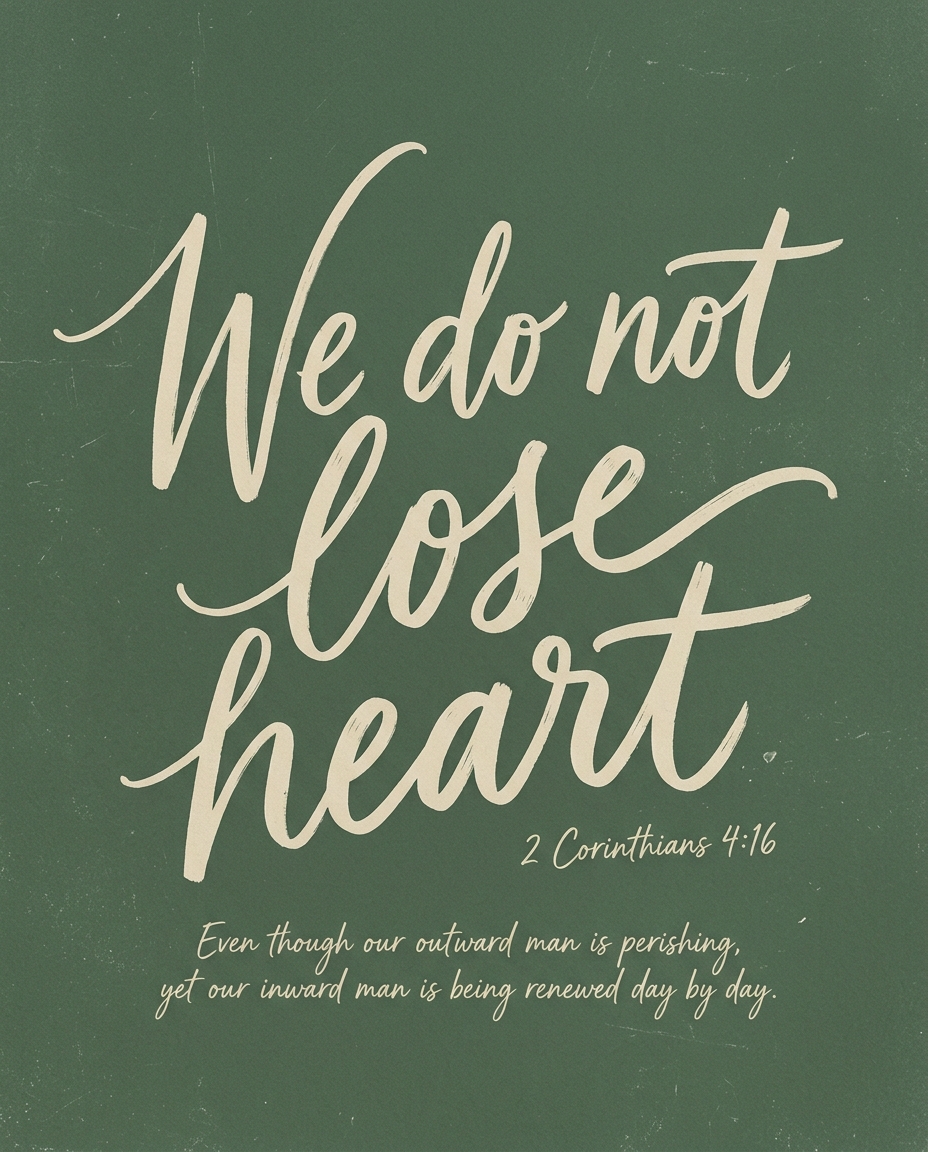
We need to renew our strength. Go back to him. Second Corinthians, 417 says this. Therefore, we do not lose heart. You don't have to raise your hand, but is there anyone besides me that sometimes loses heart?
2 Corinthians 4:16-18 20:37"Therefore, we do not lose heart. Even though our outward man is perishing, yet our inward man is being renewed day by day. For our light affliction is but for a moment, is working in us a far more exceeding and eternal weight in glory. While we do not look at the things which are seen, but at the things which are not seen. For the things that are seen is temporary. But the things which are not seen are eternal."
A few honest people. And I know the rest of you are honest too. Paul says this. First Corinthians, Second Corinthians, chapter four, verse there. Therefore, we do not lose heart. Even though our outward man is perishing, yet our inward man is being renewed. Day by day. For our light affliction is but for a moment, is working in us a far more exceeding and eternal weight in glory.
When Faith Falters: Martha and Mary's Grief
That's what you're going this through. That's why he allowed Lazarus to go through for the glory of God. And what a miracle they were about to see. Verse 18 of Second Corinthians says, While we do not look at the things which are seen, but at the things which are not seen. For the things, the things that are seen is temporary. But the things which are not seen are eternal. Have you ever driven by an old house that is almost at the point of falling down? At one time it was in its glory.
That's really what everything is going to be like. You ever seen an old car drive by a car that's for sale and it's from, you know, the 60s and it's a classic car. One day it's going to end in the junkyard or worse. Things that we go through, it's temporary. God's glory is for eternal. Secondly, following is foundational.
John 11:16 22:02"Thomas, who is called the twin, said to his fellow disciples, let us also go that we may die with him."
Jesus' Compassionate Response: Weeping at the Tomb
There are some lessons that we learn from danger. Look at what Thomas says in verse 16. Now who is Thomas? What do we call him? Oh, shame on you. Oh man, shame on me. I set you up for that. Why? Because doubt, he didn't always doubt. There were times whenever his faith was stronger than anyone else's. And verse 16 is one of those. After Jesus is resurrected, he went to India. One of the farthest reaches for going out and died a martyr's death according to church tradition. But look at verse 16. He was not afraid. He says, Thomas, who is called the twin, said to his fellow disciples, let us also go that we may die with him.
What a bold statement. What a rap he gives. That's for being a doubter. You know why he probably wasn't there whenever Jesus was resurrected? He wasn't afraid. He wasn't cowering behind locked doors like the other disciples. Maybe he was going out and say, you took my savior. Take me too. I'm willing to die with him. What a bold man. How much God calls for us to be bold. And why? Because following is formational. Thomas lined up. And was not doubting here. He was brave. He was bold. But lesson number three is this. Death is intentional.
Death is intentional. Our third lesson. Jesus purposely waited for Lazarus to die. Probably by the time he got it, he was already two days dead. At least a day and a half. By the time he got there walking there, he was four days dead. God has a purpose in death.
Primarily to save us from the sinful world. Remember Genesis chapter 3, 22? Adam ate the fruit. Eve ate the fruit. They suddenly were in a fallen nature. But there was another tree in that garden. Besides the tree of the knowledge of good and evil. Now I've asked this to our church on Wednesday nights. And they answered correctly. Why did God kick Adam and Eve out of the Garden of Eden? So that they would not eat of the tree of life. And forever be in that fallen state. Of sinfulness. Of separation. Of sickness. This world is not our home.
This is temporary. Death is intentional. God put an angel with a sword to guard the entrance to the tree of life. So that Adam wouldn't reach up and eat the fruit that he probably should have grabbed in the first place. But in God's divine foreknowledge, he allowed him to live longer than we've lived. But eventually to die.
Death is intentional. That's why he placed the cherubim there. East of the Garden of Eden. With a flaming sword turning every which way to guard the way of the tree of life. God did not and does not want to die. to die. He doesn't want us to live forever.
Here in this fallen state of sin. But if we follow Jesus. If we walk. His light will guide us. Regardless of our circumstances. Keep your eye on the goal. Keep your eye on the prize. Keep your eye riveted to the cross. And say God someday I will die. But I want to go out in a blaze of glory. I want to go out like Chuck Norris.
Death is Inevitable But Not Final: The Judgment
I want to go out in a blaze of glory. Being to go out in a blaze of glory. Being legendary. Leveling up. Not aging. Not saying I've done my time. The only place that should ever be said to any of us is on our tombstone. I've done my time.
While your heart is still beating. God has a purpose for you. Frequent statement made by missionaries. Serving God is the best place to be. Is in the center of God's will. Notice they don't say the safest place. Because we've all known. We've all known of missionaries. Who have died on the mission field.
It's not the safest place. But it is the best place. God will assure us of this. He will be glorified in death. Or in life. Grace point number two says. Following Christ in his light may be costly. It may be hard. To go and invite that neighbor. To forgive that person. Who betrayed you. To pray for the one that hates you. Or even to love someone. Who has despitefully used you. Oh I heard a sermon this week. I listened to the very end. I alluded to forgiven by Timothy Keller. It's a hard book. If you've ever been hurt. And is there anybody that's not been hurt? We've all been hurt. But yet God calls us to love those who have hurt us.
But it's hard. It's hard. I preach a crucified savior. We glory in the cross. Because a cross is not an emblem to wear around our neck. Although that gives glory to God too. The cross is the diaphan. Death is intentional. And sometimes it is an intentional death. Spiritually to our way of what we want to do.
Number three. When faith falters. There's some lessons from death. Doubt. My wife read verses 20 through 27. So we won't go through there. But Mary was always at the feet of Jesus. But Martha the one who first met Jesus was a doer. Jesus is coming. Well I'm going to go see him. Oh you're grieving. No I'm going to go see Jesus. She was a doer. She was cleaning whenever Mary was sitting at the feet of Jesus. We'll see. Or actually this time last year. I preached on Mary always at the feet of Jesus. You'll see him. Her listening to Jesus. And learning from Jesus.
But it was Martha who came out and professed her faith first. There are some people who are in church every week. Listening to Jesus. But never doing.
And I'm not talking about you guys. But there are people who are like that. Always listening. Paul said. But never coming to the full knowledge of the truth. There's a time when we need to be doers of the word. And not hearers only. Deceiving ourselves. Mary was a doer. I mean Martha was a doer. Mary was sitting there at the feet of Jesus in the past. But Martha went out there and confronted him. And this is where we get that fifth I am statement. Now if you've not been here as part of that. If you've never studied. There was precisely seven miracles outside of the resurrection in the gospel of John. And seven I am statements.
Every I am statement is a testimony. That Jesus was Yahweh. Which in Hebrew is I am who I am. Jesus was and is and always will be the great I am. But here in John chapter 11. He says I am the resurrection and the life. Anyone who believes in me will live even after death.
John 11:28-37 29:56"And when she had said these things she went away and secretly called Mary her sister. Saying the teacher has come and is calling for you. And as soon as she heard this. She arose quickly and came to him. Now Jesus who had not yet come to the town. But was in the place where Martha had met him. Then the Jews who were with her in her house. Comforting her when they saw Mary rose up quickly and went out. Followed her saying oh she must be going to the tomb to weep there."
Martha then goes and gets Mary. Let's pick it up in verse 28. And when she had said these. Things she went away and secretly called Mary her sister. Saying the teacher has come and is calling for you. And as soon as she heard this. She arose quickly and came to him. Now Jesus who had not yet come to the town. But was in the place where he had met Martha. Where Martha had met him. Then the Jews who were with her in her house. Comforting her when they saw Mary rose up quickly. And went out. Followed her saying oh she must be going to the tomb to weep there. She was going to see the life giver.
Moving the Stone: Faith Requires Action
They assumed she was going to weep at the tomb. You know they wept for days. But that third day was usually the end of the weeping. And it was a time where they continued to grieve. But they moved on. They said well there's no hope after three days. Here it was the fourth day. And Mary was still grieving. They come with him. Verse. 32. It says when Mary came. Where Jesus was she saw him. Where did she fall? At his feet. Saying to him Lord. If you had been here. My brother would not have died. Word for word what Melissa read.
John 11:32-35 30:38"When Mary came where Jesus was she saw him. She fell at his feet saying to him Lord if you had been here my brother would not have died."
They must have been saying that over and over again. Oh if Jesus would have been here. My brother wouldn't have died. Oh if Jesus had been here. My brother wouldn't have died. Oh if Jesus had been here. Here Lazarus would still be alive. We felt that way at a funeral. We felt that way before. We have regret. We have thoughts. But she came to Jesus. And in her grief Jesus wept.
Where have you laid him? Look on the front cover of the bulletin. There's a picture of Mary at his feet. Jesus compassionate. Some versions. Only one but enough to be quoted. Said that he was angry. My version says he groaned in his spirit. It could have been interpreted two different ways. But I believe he groaned. He moaned. He wept. He hurts. He's not a God who can't be touched with our afflictions.
He was troubled. He saw what happens when men sin and women sin. And results in death. And separation. He was touched by that. And God cares where you're at. Memorize the reference. 10 or 1135. The shortest verse with the greatest impact. Jesus wept. We all know the verse. Now you know where you can find it. Why? It was at a funeral. And what did they say about Jesus?
John 11:35 32:23"Jesus wept."
Oh see how he loved him. When you weep over someone it's not a lack of faith. It's a statement of saying I love that lost one. And Jesus loved Lazarus. We can weep. And then others scornfully said could not this man who opened the eyes of the blind have kept this man from dying? Two ways to view death. A famous person if I said his name became an atheist.
Because his sister died and he prayed and God didn't answer his prayers. Another person can be a four -year -old child who lost his dad and then lost his grandfather and then lost his father. And say death is inevitable. And I want to give my life to ministry. I'm not bragging on that man. But I'm saying one person will say look how he loved him. And another person would say could he not have.
Saved him. As we look at this we see that. What happens whenever faith falters.
We need to cling to Jesus. We need to fall at his feet. We don't need to say Lord if you'd only been here. He was there all along.
The emotions they felt Jesus recognized and he reflected them. And if Jesus wept surely God understands that we too will mourn whenever we lose a loved one. If we trust him. him. If we truly love him.
Jesus is the resurrection of the life. And he's the only one that we need to put our faith in.
Funerals Are Not Final: Deliverance From Death
Our lesson from this is that death is inevitable. Hebrews 927 it is appointed for men to die once and then comes the judgment. Once we die it's too late to Paul call upon the name of the Lord to ask him to come in. Even the rich man who is in the parable of.
Lazarus and the rich man. Ironic isn't it. He said didn't say Lord get me out of this torment. He said warn my brothers who are still alive. He knew it was too late for him. He had rejected accepting Christ. And it was too late for him. My question is for you. You look nice on the outside but only God knows your heart. Have you truly trusted Jesus Christ as your Lord and Savior. Death is inevitable. Everyone who lives will one day die. And after this comes the judgment. For a Christian this earthly life is a small segment of eternal life. Second Corinthians 5 .8 says this. We are confident yes rather well pleased rather to be absent from the body and to be present with the Lord.
John 11 .15 the death of Lazarus caused grief to Mary and Martha but for Jesus he was glad. You say why? Well I'll tell you why. I think Lazarus was even mad when he brought him back. He said oh I'm back here again. Oh my. I'm going to have to go through this sickness and death once again.
There's a struggle that we all go through. But from this side it is hard. But from God's side it is glory. The adversity that we grow through in our faith are going to put an eternal weight for us. Psalm 116 .15 says. It says precious in the sight of the Lord are the death of his saints. Because it's homecoming for him. I love it whenever our family gets together. Miss Pat had a birthday yesterday. Had all of her family and she was so happy.
Imagine what that reunion is like when we get to heaven. Glorious. Grace Point 3 says delays are not God's denials.
Invitation to Trust: Your Father's Promise
One thing to profess faith. It's another thing to move. The stone. Even though it raises a stink.
I had a story about a skunk. And I told my Sunday school class. I'll tell it as quickly as I can. And Chuck Swindoll told this story about this woman who had eight children. And she came home after going grocery shopping. And they were all being very quiet around a table. And whenever she went into the house. She put down her groceries. And wondered why five of their kids were being so quiet. And they were having a great. Wonderful time with five of the most beautiful.
Wonderful skunks. She has ever seen. And she reacted the way that some of y 'all reacted just now. She screamed. And she said children run. So they picked up the skunks. And each one ran in five different directions. One ran to the bedroom. One ran to the kitchen. One to the living room. All around to different places. Locking the doors behind them. And the woman was just beside them. And she screamed out even louder. And when she screamed out even louder. Those children squeezed the skunks. And I'll just tell you how Chuck Swindoll ended it. Skunks don't like to be squashed.
Sometimes whenever we have to live the way that God wants us to. We have to be willing to raise a stink. Jesus said move that stone. And he did. Martha says oh Lord if you move that stone. It's going to raise a stink. That leads us to the final point. Funerals are not final.
Lessons from deliverance. There is no invincibility in death. It's going to die one day. Death is not invincible. We can be delivered from it. Death is guaranteed. We have cause to rejoice that Jesus has overcome it. That's the other thing that's important. Death is inevitable. Taxes. Wouldn't you be rejoicing this time as we look at April 15th? I still haven't done my taxes yet. But I need to. What if Jesus said you don't have to pay taxes the rest of your life? I think there might be more hallelujahs from that. Than there is from the fact that he defeated the other thing that is inevitable. But not invincible.
The only way to beat death is to have belief in Jesus Christ. Do you believe this? Jesus asked Martha. Yes Lord I believe. That you are the resurrection of life. Belief to a Christian is not agreement but it's an assurance.
Belief is not just agreeing with God. Mentally a sin. Oh yeah I believe in God. No it's an assurance. I put in my faith in him. Only he can deliver us from the death because he defeated death himself. When Lazarus was raised from the dead it was a symbol of Jesus' power and resurrection. Power of Jesus. A new life.
One day all of us as believers we're going to be raised up from the dead. It's not a matter if our bodies are decayed or cremated or just eaten by a shark. Deteriorated where we can't even find them.
That's not a problem for God. He's going to give us a new body. In fact the more the decay the greater the glory he's going to get. Resurrection can be the work of God's glory. I want you to be there. I want to be there. I'll be on the right hand side of the golden gates. Okay I'll just wait for you. Say come on. Come on in. I told you. Didn't I tell you about this place? And Jesus up there said I want to show you the glory. We're going to see that in John 17. He said oh Lord I want to show them the glory that I had with you before the world began.
We get to see that. We get to see Jesus. We get to see and ask all those questions that don't matter of a hill of beans when we get there. Grace point four says regardless of our worldly circumstances our heavenly father has the final word. Faith is not merely. An agreement. But an assurance. Let's pray. Father I love you. I thank you God for your word. Lord I thank you that.
When I was four years old my grandfather. Climbed into my bunk bed. Paul Cowan. In Mesquite Texas. And I was crying. Because my daddy had died. And he said. I don't know. What he said. But he told me. About how much food there was in heaven. How much my father was rejoicing and fellowshipping. And at four years old. And somebody who loved to eat. That comforted my heart.
Paul Cowan was 64. I'm 64. He was born in 1902. My dad born in 1932. I was born in 62.
He had gone through my grandfather. The death of his wife in 63 at 57. She passed away. He named his son Royce Wayne. With his initials R .W. Saw the death of his son. And had words of comfort to his four year old grandson me. To say Jesus. Is taking good care of my daddy.
And I want to say to you. I want to give you that same assurance. Paul Cowan gave to me. If you have trusted Christ. There's a place Jesus said. I go to prepare a place for you. And if I go to prepare a place for you. I'll come again and receive you to myself. That where I am there you may be also. Trust Jesus today. We call this time the invitation. It's an invitation. To invite you to come to the front. Maybe to join the church. Maybe to be baptized like these two young boys were. If they could. So can you.
The Ethiopian eunuch. The Ethiopian eunuch. He Ethiopian eunuch. He said here is water. What prevents me from being baptized. Jesus said. Philip said you can be. He said Lord I believe. Baptize them right there. Philippian jailer. Middle of the. You can be absolutely
Assured that Jesus. Will take you home when death comes your way. Because I guarantee you. He says. Death is assured. That his. Forgiveness is even more assured for us. Would you stand with me at this time. Invitation as we sing this song. I surrender all.
Audio Player
This is a Plus feature ($99/mo). Upgrade to unlock audio player for your congregation.
View PlansMajor Points
Death and affliction can be interceded for through prayer—God invites us to bring our requests to Him just as Mary and Martha sent word to Jesus
Death and sickness can be instruments of God's glory, producing an eternal weight of glory that far exceeds our temporary afflictions
Death is intentional—God has a purpose in death, even using it to save humanity from an eternal fallen state, as seen when He barred Adam and Eve from the tree of life
Funerals are not final—death is defeated and not invincible because Jesus overcame it through His resurrection, and belief in Him is not mere agreement but assured trust
Discussion Questions
- 1
Pastor McKeown described death as 'intentional' — that God purposely allowed Lazarus to die for His glory. How does that idea sit with you when you think about losses you've personally experienced? Is it comforting or challenging?
- 2
Thomas is usually remembered as 'Doubting Thomas,' but Pastor McKeown pointed out that in John 11:16 he was actually the boldest of all the disciples. How does this change the way you think about Thomas, and what does it teach us about labeling people by their worst moments?
- 3
Pastor McKeown made the distinction that belief for a Christian 'is not agreement but an assurance.' What's the practical difference between mentally agreeing that God exists and having the kind of assurance Martha expressed in John 11:27?
- 4
The sermon highlighted that Martha and Mary both said the exact same words — 'Lord, if you had been here, my brother would not have died' — yet they responded differently. Martha went out to meet Jesus while Mary fell at His feet. What do these two different postures teach us about how people process grief in the presence of God?
- 5
Pastor McKeown said, 'While your heart is still beating, God has a purpose for you.' How does knowing that death is inevitable but God's purpose for your life is ongoing change the way you approach each day — especially the hard ones?
Word Studies
A rising up or standing up again, referring specifically to bodily resurrection from the dead — not merely survival of the soul but the restoration of the whole person to life.
John 11:25 — “...I am the resurrection and the life...”
To shed tears or weep silently, distinct from loud wailing (klaió); it conveys a quiet, deeply personal expression of grief and compassion.
John 11:35 — “Jesus wept.”
To snort with indignation or groan deeply within oneself, expressing intense inner agitation — whether righteous anger at death's devastation or profound emotional disturbance.
John 11:33 — “...he groaned in the spirit and was troubled.”
This Week's Reading Plan
Go deeper this week with the passages from this sermon.
Read John 11 for the full context
What stands out to you in this passage? How does it connect to the sermon?
Read John 10 for the full context
Is there a promise, command, or truth here that applies to your life this week?
Read James 5 for the full context
How does this passage shape the way you see God's character?
Read 2 Corinthians 4 for the full context
What would change in your daily life if you took this passage seriously?
Read Philippians 4 for the full context
As you finish the week, what one truth from this series of readings will you carry forward?
Cross References
Fulfills the promise Pastor McKeown emphasized — that death will ultimately be destroyed and 'be no more,' completing the trajectory from Lazarus's temporary resurrection to the eternal state where God wipes away every tear.
Supports the sermon's point that God uses affliction and even death as instruments of His glory, working all things — including painful delays — together for good for those who love Him.
The valley of dry bones vision provides an Old Testament parallel to Lazarus's raising: God commands dead bones to live again, demonstrating His sovereign power over death and foreshadowing bodily resurrection.
God's declaration 'O Death, where are your plagues? O Sheol, where is your sting?' connects to the sermon's theme that death is a defeated enemy whose own destruction is guaranteed — the Old Testament root of Paul's triumph in 1 Corinthians 15.
Addresses the sermon's point about God's intentional delays: though the Lord causes grief, He will have compassion according to His steadfast love — He does not willingly afflict, even when His purposes require painful waiting.
Further Reading
Forgive: Why Should I and How Can I?
by Timothy Keller
A Grief Observed
by C.S. Lewis
The Miracles of Jesus: How the Savior's Mighty Acts Serve as Signs of Redemption
by Vern S. Poythress